
Aligned DexWorld Released:The First Dataset to Unite Human, Simulation and Real-Robot Data
During WAIC 2026, on July 17, DexForce Technology officially released and open-sourced Aligned DexWorld — the first large-scale spatiotemporally action-aligned dataset, spanning humans, simulation, and real robots with alignment across time, space, and action, providing standardized, reusable, and composable core data infrastructure for embodied AI models to break through the scaling bottleneck.
Aligned DexWorld integrates mainstream public datasets including Droid, AgiBotWorld-Beta, RoboMIND, RH20T, LIBERO, RoboTwin, and VITRA, applies unified standardized post-processing, and covers diverse data types such as human demonstration, real-robot teleoperation, simulation synthesis, and first-person view.1
This major open-source release establishes a brand-new industry-wide R&D paradigm of “data alignment before data volume”. Aligned DexWorld is freely open to academic institutions and industry developers, sharply lowering the training barrier for general-purpose robots and Physical AI models, and accelerating technology deployment across the industry.
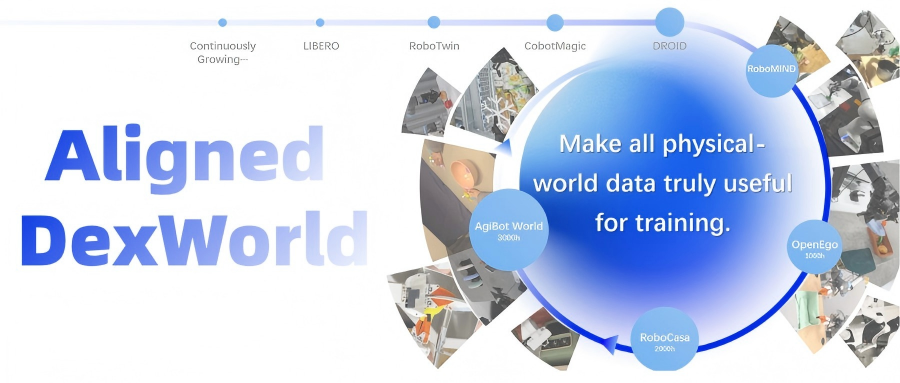
01 More Data Does Not Necessarily Mean More Effective Data
The capability leaps of large language models and vision foundation models rest fundamentally on large-scale training over massive homogeneous data under a unified representation. This mature scaling law has never carried over directly to embodied AI: the crux is not a shortage of total data, but the inability of heterogeneous data to learn together effectively.
Unlike text and images, which come with a naturally unified Token representation system, robot manipulation data is inherently fragmented and heterogeneous: camera intrinsics and extrinsics and mounting viewpoints differ across capture devices; coordinate systems, reference baselines, and end-effector definitions differ significantly across robot embodiments; and operation speed, control frequency, and motion trajectories vary widely across operators and hardware.
Pile up vast amounts of robot and human manipulation samples, and mixed training on unaligned heterogeneous data not only fails to improve model generalization but also triggers severe negative transfer, ending in a situation where the more data piles up, the more the model stands still or even fails to converge.
This creates a dilemma common across the industry: more data does not necessarily mean more effective data.
Around the time DexForce Technology first released Dexterity-BEV in June, leading teams at home and abroad published similar work, such as Alibaba Qwen-RobotManip and Georgia Tech EgoWAM. Multiple heavyweight industry studies have converged on a new consensus for embodied AI: data alignment is the prerequisite core condition for large-scale robot training. To scale the capability of embodied models, the unified representation of multi-source heterogeneous data must be solved first. Aligned DexWorld from DexForce Technology was born to address this core industry pain point.
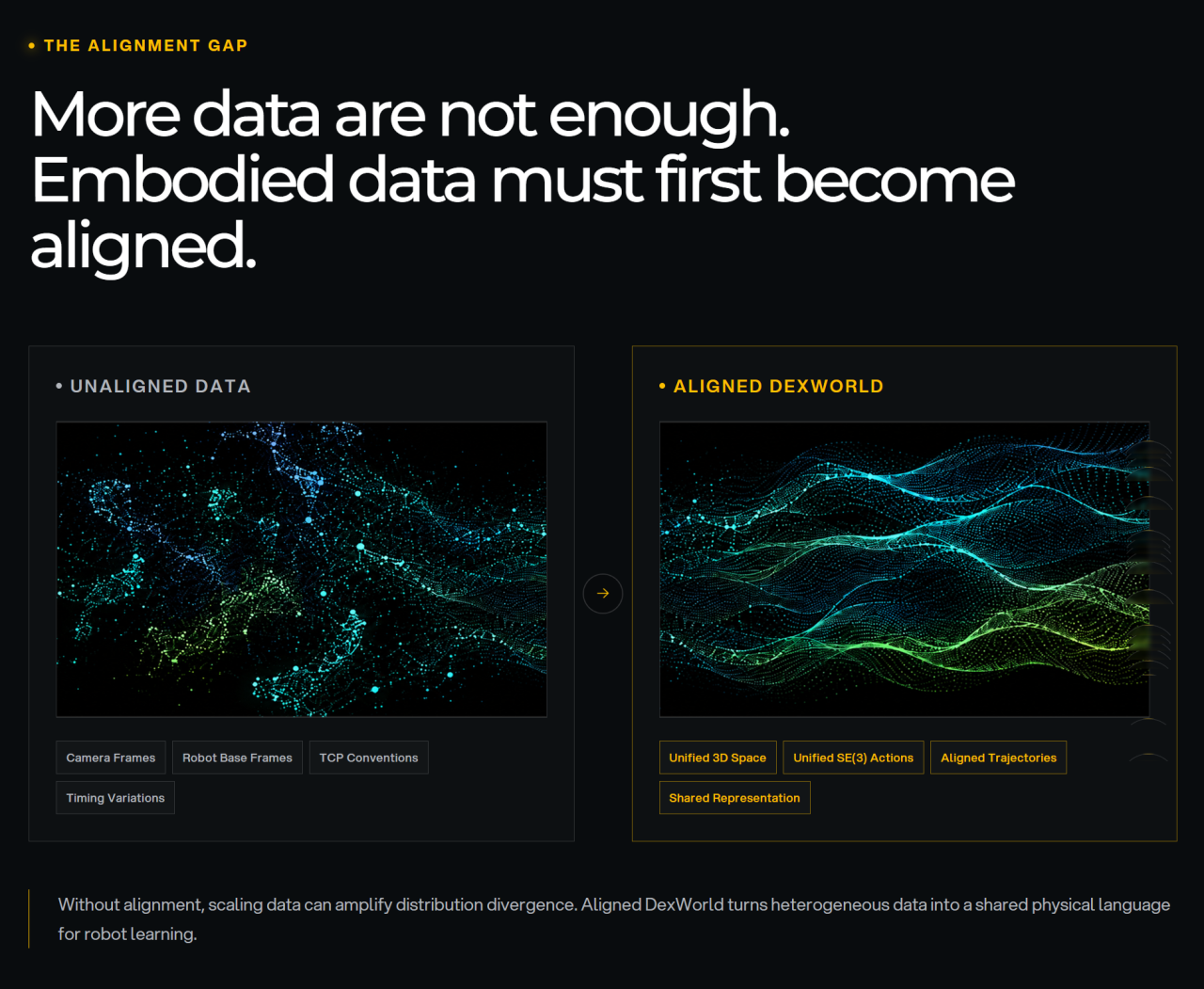
02 Aligned DexWorld: Human Data and Robot Data Now “Speak the Same Physical Language”
In June this year, DexForce introduced Dexterity-BEV unified representation technology, an attempt to systematically push BEV methodology into the data infrastructure layer of embodied AI; in the same month, DexForce took first place worldwide in Track 2 of the WorldArena world model leaderboard on the strength of its hardcore technology; and only two months later, DexForce delivered another major data milestone, officially open-sourcing the million-scale spatiotemporally action-aligned dataset Aligned DexWorld at WAIC 2026, building a solid data foundation for the scaling of general embodied models through sustained, efficient iteration of underlying technology.
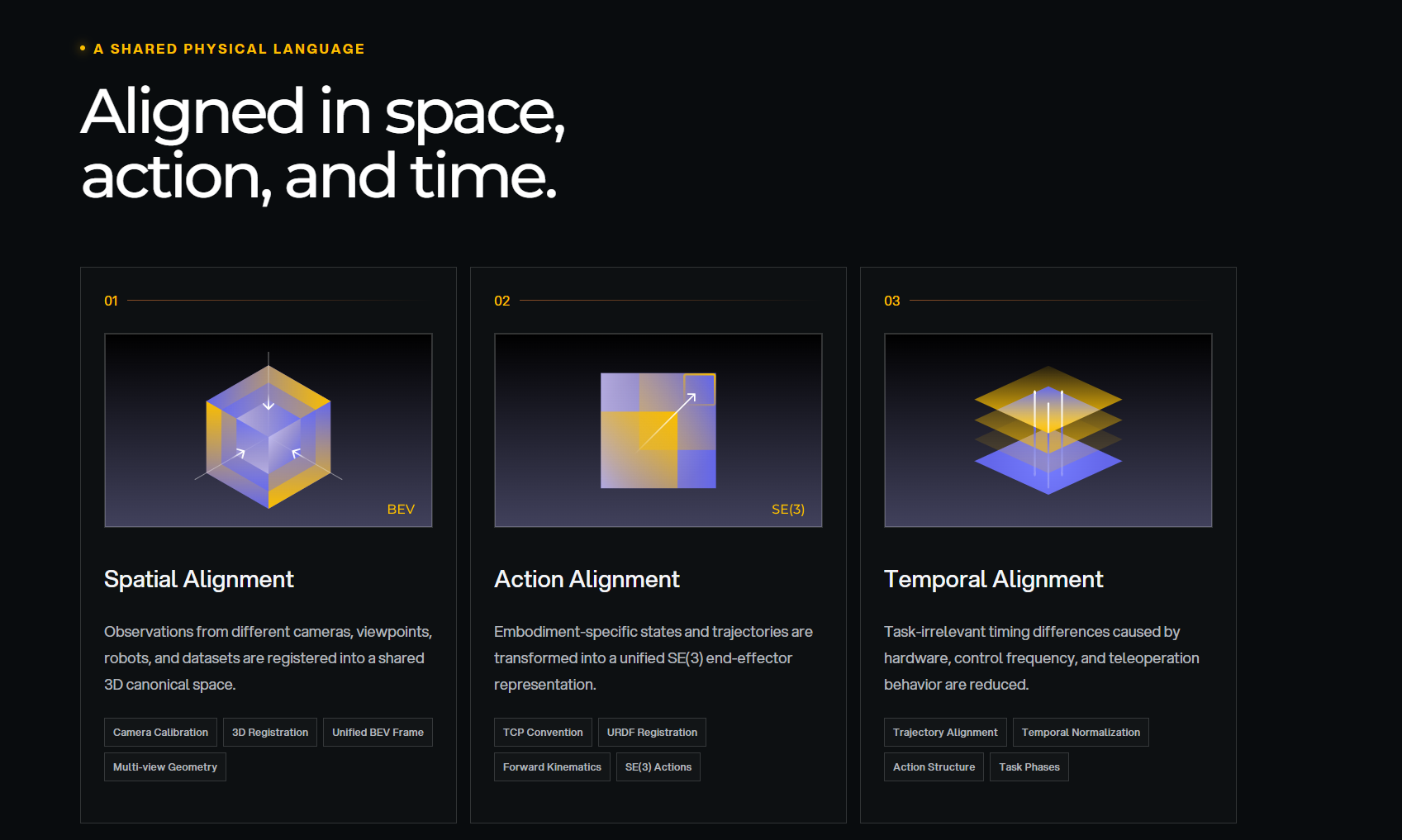
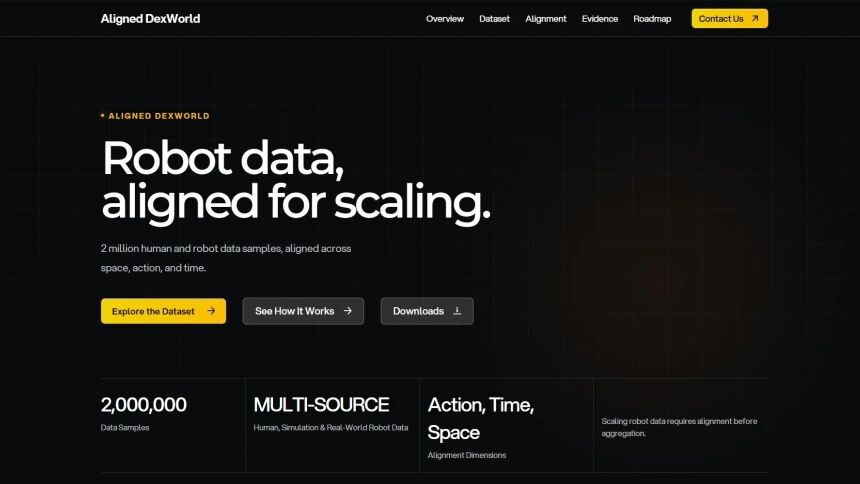
Aligned DexWorld is a high-quality heterogeneous dataset purpose-built for large-scale pre-training of embodied models, containing in total over 2 million human and robot data samples, including real-robot data from different embodiments (humanoid robots and robotic arms), simulation data, and first-person human hand demonstrations. Unlike traditional datasets that merely tidy up formats, the core value of Aligned DexWorld lies in deep physical-level alignment: unifying all heterogeneous data in physical terms across the three core dimensions of space, action, and time, so that the 3D world the model observes and the robot actions it executes correspond and interlock completely:
- Spatial alignment: unifies the 3D coordinate systems of multiple cameras, viewpoints, and devices, mapping all observations into a standard global 3D frame, eliminating the observation bias caused by viewpoint and device differences, and letting the model focus on learning the physical features of real scenes.
- Action alignment: discards representations tied to specific hardware, standardizes robot end-effector actions, and converts manipulation trajectories and poses from different embodiments into a universal physical representation, making data transferable and jointly trainable across robots and devices.
- Temporal alignment: normalizes the timing differences caused by hardware frequencies and human operating habits, preserves core effective information such as action order, task logic, and motion trajectories, filters out invalid temporal noise, and unifies the temporal expression logic of similar tasks.
For the alignment needs of 2 million large-scale heterogeneous data points, the dataset implements a closed-loop standardization pipeline of manual calibration, geometric solving, model assistance, and manual verification. Visual calibration tools paired with algorithmic optimization correct data deviations precisely, avoiding the errors of fully automatic processing, so that the alignment logic of every single data point is traceable, verifiable, and reproducible, safeguarding the overall precision and stability of the large-scale data.
Manually segmenting and annotating data at this scale would be prohibitively expensive, so DexForce built a fully automatic annotation pipeline in two steps: behavior segmentation and per-segment semantic annotation. Candidate segments are first generated from robot motion speed and gripper open-close state, then a VLM merges the candidate segments, divides them into standard subtasks, and automatically generates text annotations, automating the entire process.
This automated annotation scheme slashes labor costs and efficiently produces massive, standardized, uniformly aligned subtask data; high-quality modular data markedly improves the generalization of embodied models and reduces the data needed to train for new tasks, building a low-cost, reusable data production foundation for the entire robotics industry and accelerating the large-scale deployment of general Physical AI.
Aligned DexWorld has already delivered multiple industry breakthroughs at the underlying data infrastructure layer:
>>Building a standardized data foundation
It achieves, for the first time, unified physical-level alignment of large-scale human data and real-robot data, smoothing away the data heterogeneity caused by different devices, viewpoints, and capture systems, letting multi-source data that was previously isolated and impossible to interoperate jointly participate in model pre-training, and maximizing data utilization.
>>Lowering the barrier to large-scale model training, ready out of the box
With complete unified alignment specifications for space, action, and time, it spares developers the large amount of redundant work of traditional development — coordinate adaptation, heterogeneous data cleaning, and cross-embodiment alignment — so they can focus on learning the laws of physical interaction and task semantics, effectively reducing the compute and time cost of model pre-training and fine-tuning.
>>Establishing the industry alignment paradigm, supporting the scaling of general embodied models
It fills the industry gap in data infrastructure for spatial, action, and temporal alignment, providing a deployable, reusable standard paradigm for future multi-source data fusion, cross-embodiment model transfer, and the training of general embodied foundation models, and pushing embodied AI firmly into a new stage of effective scaling.
The Aligned DexWorld dataset is now officially open source. Academic and industry developers worldwide are welcome to download and use it!
🔗Website: https://dexforce.com/aligned-DexWorld/
While the industry crowds into iterating upper-layer world models, DexForce insists on working deep on the underlying data infrastructure at the same time, continuously filling foundational gaps and steadily moving embodied AI into a new stage of effective scaling. Going forward, DexForce Technology will keep expanding the scale and capability of the Aligned DexWorld dataset and improving the embodied data ecosystem, using a high-quality data foundation to empower the large-scale deployment of general-purpose humanoid robots and embodied AI technology.
[1] Aligned DexWorld provides standardized representations, alignment annotations, and processing tools built upon multiple source datasets. Each source dataset remains subject to its original license and terms of use. Certain source data are not redistributed and must be obtained directly from the original providers.