
WAIC 2026 Roundup. DexForce Solidifies the Foundation Layer, Delivering Real Embodied Productivity
From July 17 to 20, the 2026 World Artificial Intelligence Conference (WAIC) was successfully held in Shanghai. As the premier AI industry event in China, it brought together top global companies and cutting-edge achievements, presenting the latest trends in the industrialization of AI.
At this edition, DexForce Technology released a concentrated wave of core technologies and deployment results:
- Officially open-sourced Aligned DexWorld, the first large-scale spatiotemporally action-aligned dataset to span humans, simulation, and real robots;
- Publicly demonstrated the DexVerse™ simulation engine and generative simulation technology for the first time;
- Exhibited the only robot at this WAIC capable of autonomously completing the full retail scanning workflow, alongside diverse demos including precision smartphone boxing, coffee making, and Chinese chess playing;
Presenting a complete technology chain from underlying data and the simulation engine to real-robot deployment, DexForce Technology is delivering real, deployable, and mass-producible embodied productivity to industry.
01 Open-Sourcing Aligned DexWorld, So Human Data and Robot Data “Speak the Same Physical Language”
While the industry at large focuses on iterating upper-layer world models, DexForce Technology keeps working deep on the underlying infrastructure. At this WAIC, DexForce officially open-sourced Aligned DexWorld — the first large-scale spatiotemporally action-aligned dataset spanning humans, simulation, and real robots, tackling the negative-transfer problem of heterogeneous data, where piling up more data makes performance worse, and providing a standardized, reusable data foundation for large-scale training of embodied models.
This marks another near-term breakthrough in underlying technology from DexForce. In June this year, DexForce debuted Dexterity-BEV, a unified spatial representation framework for embodied AI, creatively introducing the BEV bird's-eye-view representation paradigm into robotics, unifying multi-view visual observations, robot states, and actions in one 3D physical coordinate system, and solving the fragmented viewpoints of traditional visual perception that prevented shared training.
Just one month later, Aligned DexWorld has landed, upgrading the industry approach to data R&D from “piling up data volume” to “alignment first, effective training”. The dataset fuses multi-source samples of human demonstration, real-robot teleoperation, and simulation synthesis, and through 3D physical-level alignment makes heterogeneous data truly interoperable, usable, and jointly trainable.
This major open-source release establishes a brand-new industry-wide R&D paradigm of “data alignment before data volume”. Aligned DexWorld is freely open to academic institutions and industry developers, sharply lowering the training barrier for general-purpose robots and Physical AI models, and accelerating technology deployment across the industry.
02 Debut of the DexVerse™ Simulation Engine and Generative Simulation, Feeding World Models a Steady Stream of Effective Data
The Scaling Law of embodied AI depends on large-scale data, yet collecting data solely through real-robot teleoperation struggles to meet the twin challenges of quantity and scene coverage. Building a simulation engine that generates synthetic data at scale, forming a continuous and controllable data supply capability, is the inevitable path past the current data bottleneck.
At the show, DexForce Technology publicly unveiled the capabilities of the DexVerse™ generative simulation engine for the first time, a domestically developed and self-reliant infrastructure built for large-scale embodied AI training. Through its self-developed physics engine, real-time multi-physics simulation, and generative simulation, DexForce rapidly turns real scenes into virtual environments that are interactive, trainable, and capable of mass data generation, continuously supplying high-quality training data for VLAs, world models, and robot policies, which ultimately transfer to real robots and industrial lines.
To date, DexForce has applied simulation-data training to more than 1,000 industrial intelligence projects and accumulated over 70 TB of high-quality robot factory data, forming a complete closed loop from simulation data generation and embodied model training to real-robot deployment.
This gives DexForce the complete technology closed loop of “data alignment → simulation generation → model cognition → scene deployment”: Aligned DexWorld standardizes and aligns heterogeneous data across the dimensions of time, space, and action; DexForce pre-trains models on massive mixed data so they learn general knowledge of the physical world and manipulation capability; facing a new scene, the DexVerse simulation engine and generative simulation need only hours to generate targeted training data and rapidly adapt the model; and the self-developed world model DexWorldModel predicts the success probability of different action policies from the environment state, autonomously selecting the optimal output and supporting stable, generalizing deployment of robots in real industrial scenes.
03 The Only Robot at the Show Capable of Autonomously Completing Retail Scanning Work: Robots Move from Providing Functions to Providing Services
At this WAIC, DexForce Technology exhibited the only robot on the floor capable of autonomously completing retail scanning operations. It must grasp bottles from randomly arranged baskets, find the barcode, complete the scan, and return each bottle to its designated spot. The real difficulty lies in “finding the barcode” — the robot does not know the barcode orientation in advance and must observe, adjust its grasp posture, and decide at the same time, searching actively through continuous probing rather than mechanically replaying a preset trajectory. This ability to act, observe, and decide simultaneously is the very core of embodied AI. On site, the robot ran continuously and stably, demonstrating strong autonomy and robustness.
Another scene that drew large crowds was the precision smartphone boxing robot. Despite random offsets in phone placement, the robot autonomously completes millimeter-level assembly — taking the box, placing the phone, aligning, and closing the lid — with no human intervention. The value of this scene lies beyond the motions themselves, in the factory-grade capability it validates: a high success rate, adaptiveness to positional change, and long-term stability in continuous operation. Whether materials shift slightly or a person interferes, the system replans autonomously and carries on the task, proving its decisions rely not on fixed trajectories but on a genuine understanding of the scene and the task goal.
On the booth, DexForce also presented the DexForce W1 Pro coffee robot and a Chinese chess playing robot. From industrial assembly to retail scanning to everyday services, DexForce now covers diverse scenarios from high-precision industry to open, generalizing services.
04 DexForce Deployment Results Draw Focus from Government, Business, Media, and Investors
At this edition, the deployment results of DexForce Technology drew broad attention from government and enterprises, mainstream media, and the venture capital community.
As a portfolio company of Lens Technology, DexForce Technology placed its W1 Pro coffee robot on the Lens Technology booth for a joint display. During the event, Mao Weiming, Governor of Hunan Province, and his delegation visited the Lens Technology booth, watched the robot make coffee and experienced it first hand, and the delegation spoke highly of the dexterous manipulation capability of the W1 Pro.
The technology achievements of DexForce Technology were featured in a report by Television Broadcasts Limited (TVB) of Hong Kong, spotlighting the strength of homegrown underlying embodied technology. Rupert Hoogewerf, founder of the Hurun Report, also made a special visit to the booth to try the W1 Pro chess robot, with related coverage spreading continuously through technology and venture circles.
05 Prof. Kui Jia Joins Roundtable, Laying Out the Deployment Logic of Physical Token Economics
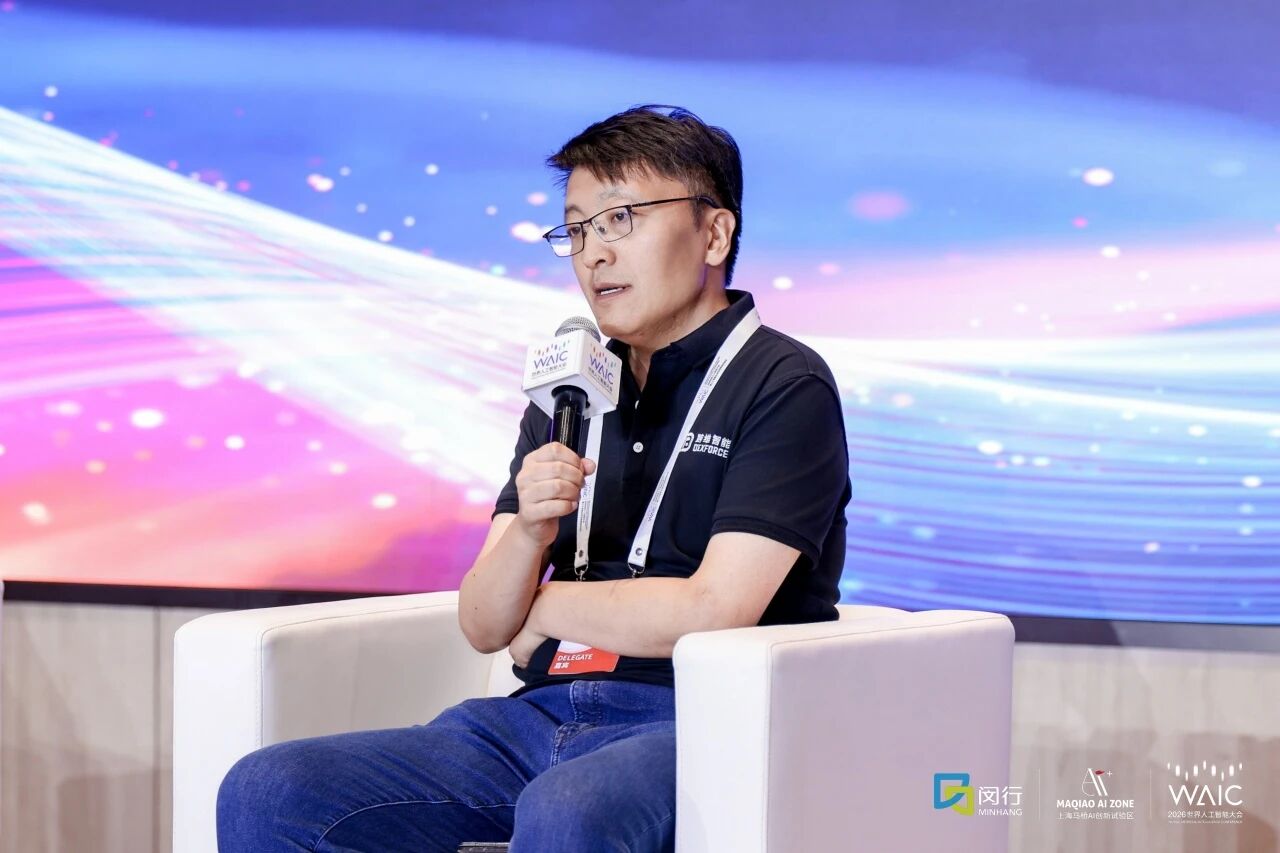
On July 19, the Shanghai Maqiao AI Innovation Pilot Zone Embodied AI Industry Ecosystem Forum was held at the Shanghai World Expo Exhibition and Convention Center, guided by the Shanghai Municipal Commission of Economy and Informatization, the Minhang District Government, and the WAIC Organizing Committee Office, hosted by the Minhang District Commission of Economy, the Shanghai Maqiao AI Innovation Pilot Zone, and the Maqiao Town Government, and co-organized by Jiazi Guangnian. Prof. Kui Jia, founder of DexForce Technology, was invited to join the roundtable “From Demo to Real Work: How Embodied AI Enters Real Scenes”, exchanging views on stage with founders of several industry-leading companies.
At the forum, Prof. Kui Jia reiterated the Physical Token Economics viewpoint he had earlier proposed: many solutions in the industry still rely on a mode of massive manually collected data, keeping deployment costs high, stretching industry cycles, and limiting the path to commercialization. For embodied AI to achieve truly large-scale deployment, it must pursue semantic generalization and physical generalization together, delivering the highest real-world returns at the lowest cost.
He noted that semantic generalization relies on lightweight, routine human-robot co-creation data collection for pre-training, moving away from the traditional mode of high-intensity dedicated data collection, while physical generalization leverages generative simulation for efficient post-training, mass-producing high-precision physical scene data. Combined with the DexForce Dexterity-BEV unified 3D representation architecture, the full chain of data collection, model training, and inference deployment cuts Token consumption and deployment cost, turning embodied AI from a “technology demo” into an “economically viable mass-produced product”. He stressed that the industry has entered the stage of real work: only by solving cost and generalization can large-scale deployment be achieved.
From the data foundation to the simulation engine, from core models to real-robot deployment, DexForce Technology presented a complete and clear technology path at this WAIC: evolving robots from “understanding the physical world” to “actually getting the job done”.
DexForce has built a full-chain, self-developed technology closed loop covering “data alignment → simulation generation → model cognition → scene deployment”, and has completed real-world validation across diverse scenarios such as commercial services, intelligent manufacturing, culture and tourism consumption, research, and education. While the industry still debates whether embodied AI can move from demo to mass production, DexForce gave its own answer with continuous and stable live demos on the booth, factory-grade precision, and a technology path that can scale and be reused.
The endgame of embodied AI is not showing off tricks. DexForce Technology is delivering real, deployable, and mass-producible embodied productivity to industry.