
Customer Requirements
This project was deployed at a major domestic home appliance OEM and applied to precision leak testing quality inspection stations for the core sealing parts, piping, and housing weld seams of refrigerators, washing machines, air conditioners, and other home appliances. Sealing performance directly determines product energy consumption, water and dust resistance, and service life, making it a core quality gate before products leave the factory.
Workpieces on site are mostly light-absorbing black plastic parts, high-gloss metal piping, and smooth curved housings, with faint surface features and extremely fine leak gaps; the line runs multiple models in mixed production while workpiece appearance and structure iterate quickly. The traditional approach of manual visual sampling plus simple water-bath leak testing fixtures is not only inefficient but also prone to subjective human error, so minute leak points are easily missed or misjudged, driving high after-sales rework rates for water and air leaks. Meanwhile, conventional vision solutions suffer from poor interference resistance and weak recognition of subtle defects, and cannot meet high-takt, high-precision full inspection requirements. The customer urgently needed a high-precision, highly stable 3D vision intelligent leak testing solution with rapid changeover.
On-Site Challenges
- Imaging minute defects is extremely difficult and conventional equipment fails to recognize them: leak testing targets fine defects such as micro-gaps, cold solder joints, and missing sealant, whose features are weak and low in contrast; workpieces combine highly reflective, black light-absorbing, and smooth curved materials, while ordinary 3D cameras produce noisy point clouds with lost detail and cannot capture micron-level flaws.
- Complex workshop environment and unstable detection: dynamic lighting interference on the line, slight stains on incoming workpieces, and uneven reflections easily cause traditional algorithms to misjudge or miss defects, making inspection consistency hard to guarantee.
- Mixed multi-category production exposes the limited flexibility of traditional solutions: appliance models iterate quickly and sealing structures differ greatly, so traditional inspection equipment requires dedicated parameter tuning and recalibration, with long changeover cycles that cannot adapt to flexible mass-production full inspection.
- Manual leak testing is error-prone and costly: manual visual inspection plus water-bath testing depends on experience, miss rates soar once operators grow fatigued, and slow inspection cycles cannot match automated line takt, keeping quality control labor costs stubbornly high.
Workflow
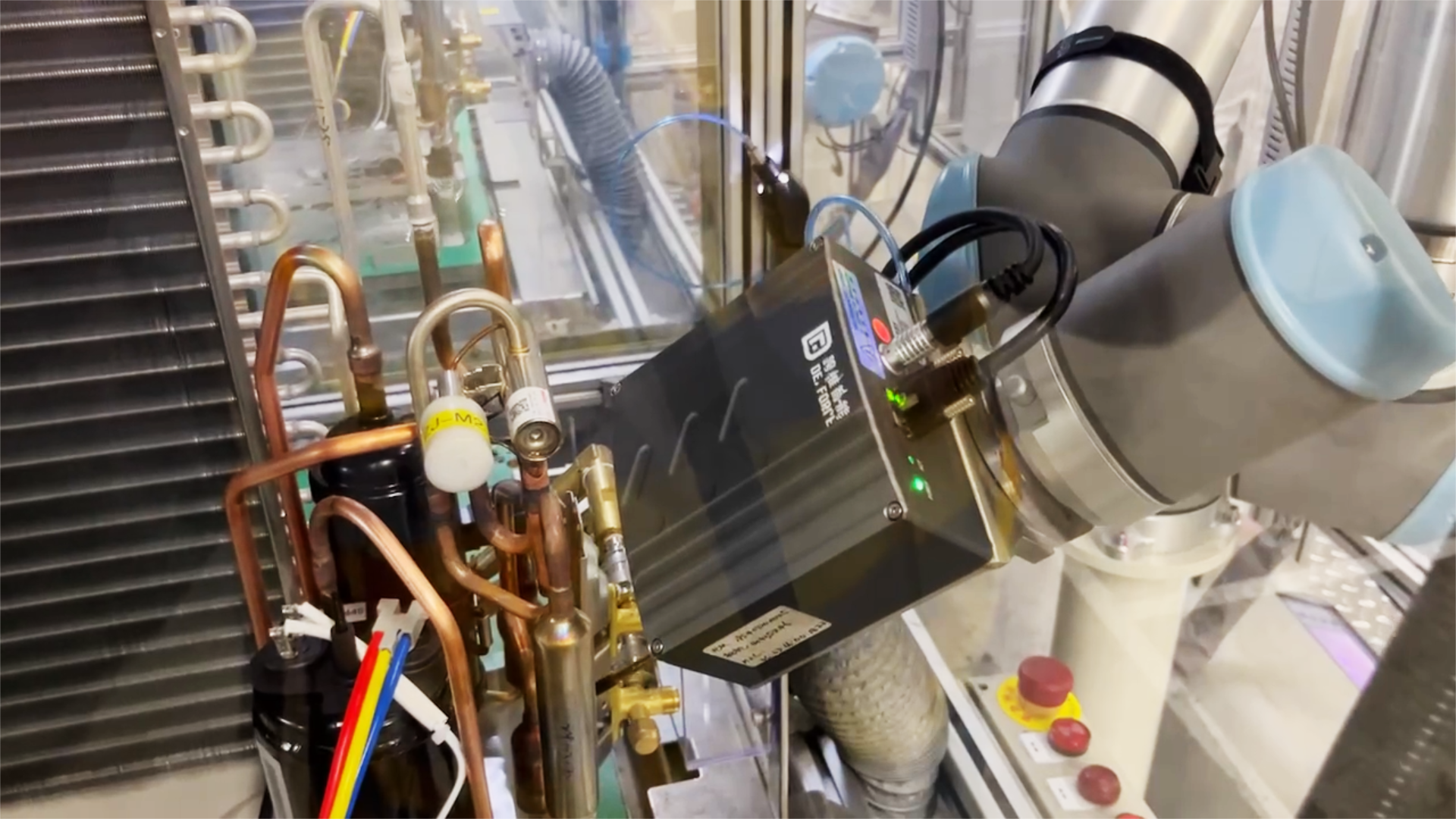
Drawing on the “XEMA DCW industrial 3D camera + DexVerse® embodied AI engine”, DexForce Technology delivered a fully automated, high-precision visual leak testing quality control solution for home appliances: the XEMA DCW camera, equipped with self-developed DLP structured-light imaging technology, performs full-field HD 3D scanning of housing weld seams, sealed piping, and mating surfaces; its strong-light compensation algorithms suppress workshop ambient light interference to faithfully reconstruct fine structural textures and output clean, noise-free point clouds rich in detail; the DexVerse® intelligent inspection algorithms compare and analyze workpiece 3D data at the pixel level, automatically identifying hidden defects such as micro-gaps, cold solder joints, and seal failures while outputting results and defect locations in real time; qualified units are released and defective units flagged with warnings, closing the loop of automated full inspection on the line.
Application Results
After this intelligent visual leak testing solution went live, the customer achieved fully automated unattended inspection at core sealing quality control stations, completely replacing the traditional manual leak testing model and eliminating the pain points of missed detection, false judgment, low efficiency, and high cost. Leveraging the high-precision imaging capabilities of XEMA DCW, the detection rate of minute defects at the station rose sharply while the rework rate for sealing failures dropped significantly; the high-speed inspection takt fully matches mass-production requirements, achieving 100% full inspection coverage. The equipment also adapts quickly to new product iterations, comprehensively upgrading the flexible quality control capability of the line and helping the customer achieve standardized, precise, and efficient intelligent production.