
DexWorldModel Tops the Ranking. The Real Test Is a Working Robot
01 VLA and World Models: A Paradigm Shift Driven by the Industry Itself
This April, something that looked small but carried deep meaning happened in the field of embodied AI.
Generalist AI — the star company founded by the team behind PaLM-E and RT-2 — released GEN-1, delivering leapfrog improvements on three core dimensions: a success rate above 99%, a 2–3x speed increase, and data volume and fine-tuning cost at just 1/10 of the previous generation. In almost the same week, its CEO Pete Florence published a blog post stating clearly: they no longer classify their own model as a VLA.
The reason this deserves to be taken seriously is that Pete Florence himself is one of the co-creators of the VLA concept.
Florence put the reason bluntly in the post: the “world model” is now welcoming its moment in the spotlight, while from 2023 to 2025 it was VLA that held the limelight.
Chasing hot topics and trends is the norm of academic research. But if your goal is Physical AGI, then the goal matters far more than the label of the “tool” in your hands.
More crucially, he punctured a fact the industry had long avoided: bringing “vision-language” training into robotics was largely because the robots did not yet have enough interaction data of their own, so the VLM was only a transitional “crutch”. Once physical interaction data reaches scale, this crutch should be taken away, rather than kept at the center of architecture design.
We need a system-level answer around a plainer question: after moving beyond VLA, what should the next-generation embodied model look like so that it can truly support robots running continuously, stably, and scalably in the real world?
This is an important distinction of stance, and also a question that every practitioner needs to rethink with a “back-to-basics” mindset.
At present, both VLA and world models are mainstream technical routes in embodied AI. Quite a bit of today’s work crowned with the name “world model” in fact belongs to the video-generation paradigm — fitting future frames in RGB pixels or a low-level visual latent space, which in essence still answers “whether the next frame matches the visual logic of real video” rather than “what action-meaningful state the world has entered”.
Such models may post good-looking numbers on video benchmarks, but once plugged into real robot tasks, they immediately expose four types of systematic bottlenecks:
-Representation bottleneck: modeling in pixel space forces the model to spend its capacity on texture, lighting, and background — information only loosely related to the task;
-Memory bottleneck: the combination of causal autoregression and KV Cache makes spatial complexity grow linearly with trajectory length; long-horizon tasks get heavier the longer they run, making stable deployment difficult;
-Inference bottleneck: perception → reasoning → execution are strictly sequential, deployment-side latency is high, the closed-loop frequency naturally cannot rise, and the robot “moves in fits and starts”;
-Data bottleneck: the model relies on fixed offline datasets for training and lacks a continuous, fresh, physically credible flow of information, making rapid evolution difficult.
If these four problems are not solved together, the word “world model” will hardly land in the world of robots.
02 Re-examining the Yardstick: Many World-Model Leaderboards Have Little to Do With Robot Tasks
After the paradigm shift, the next question — subtler but equally critical — is: how should world models actually be evaluated?
The leaderboards frequently cited today are mostly the kind built for video generation — examining the picture quality of future frames, FVD, temporal consistency, and text-video alignment. These metrics are reasonable for “generative video models”, but placed in the embodied context, the object of evaluation begins to misalign with the goal.
This comes from the empirical conclusions of peer papers. In February 2026, Tsinghua and other institutions jointly released the WorldArena benchmark, which systematically measured the relationship between visual quality and downstream embodied task capability across 14 representative world models (covering Veo 3.1, Wan 2.6, CogVideoX, Cosmos-Predict, Genie Envisioner, CtrlWorld, and others). The conclusion it gave was quite direct: High visual quality does not necessarily translate into strong embodied task capability.
Supporting this conclusion is a set of very hard numbers. EWMScore, the composite visual quality metric constructed in the paper, correlates with human subjective ratings at Pearson r = 0.825, but with task success rate when serving as an action planner the correlation is only r = 0.360 — a typical weak-correlation range.
More thought-provoking is that the paper also observed: Veo 3.1, which scored highest on visual and aesthetic metrics, showed only “improvements are limited” on embodied task metrics, accompanied by obvious semantic drift. The one that paints the most realistic picture understands interaction the least.
The essence of this matter is that the object of evaluation is misaligned:
-A generative world model asks: “Does the future footage look like a plausible video?”
-An embodied world model should rather ask: “Can this future be executed by the robot, and can it ultimately get the task done?”
The gap between these two things is far bigger than it appears on the surface. A model may well generate extremely realistic future video yet fail outright on a real robot because of inaccurate geometry, unstable dynamics, or temporal drift; conversely, a model that is not visually stunning may achieve a higher success rate on real hardware.
So the position of DexForce Technology is very clear: the only reasonable metric for an embodied world model is the success rate on downstream robot tasks.
In this sense, leaderboards like RoboTwin that take robot task success rate as the core evaluation dimension are where embodied world models should truly be scored. What they examine is not “whether you generate good-looking output”, but “whether you can keep a robot running stably through a series of diverse tasks”.
Every design choice of DexWorldModel, and every way it is evaluated, unfolds around exactly this point.
03 The DexWorldModel Tech Stack: Four Layers in Concert, Pushing the World Model Toward Closed Loops on Real Robots
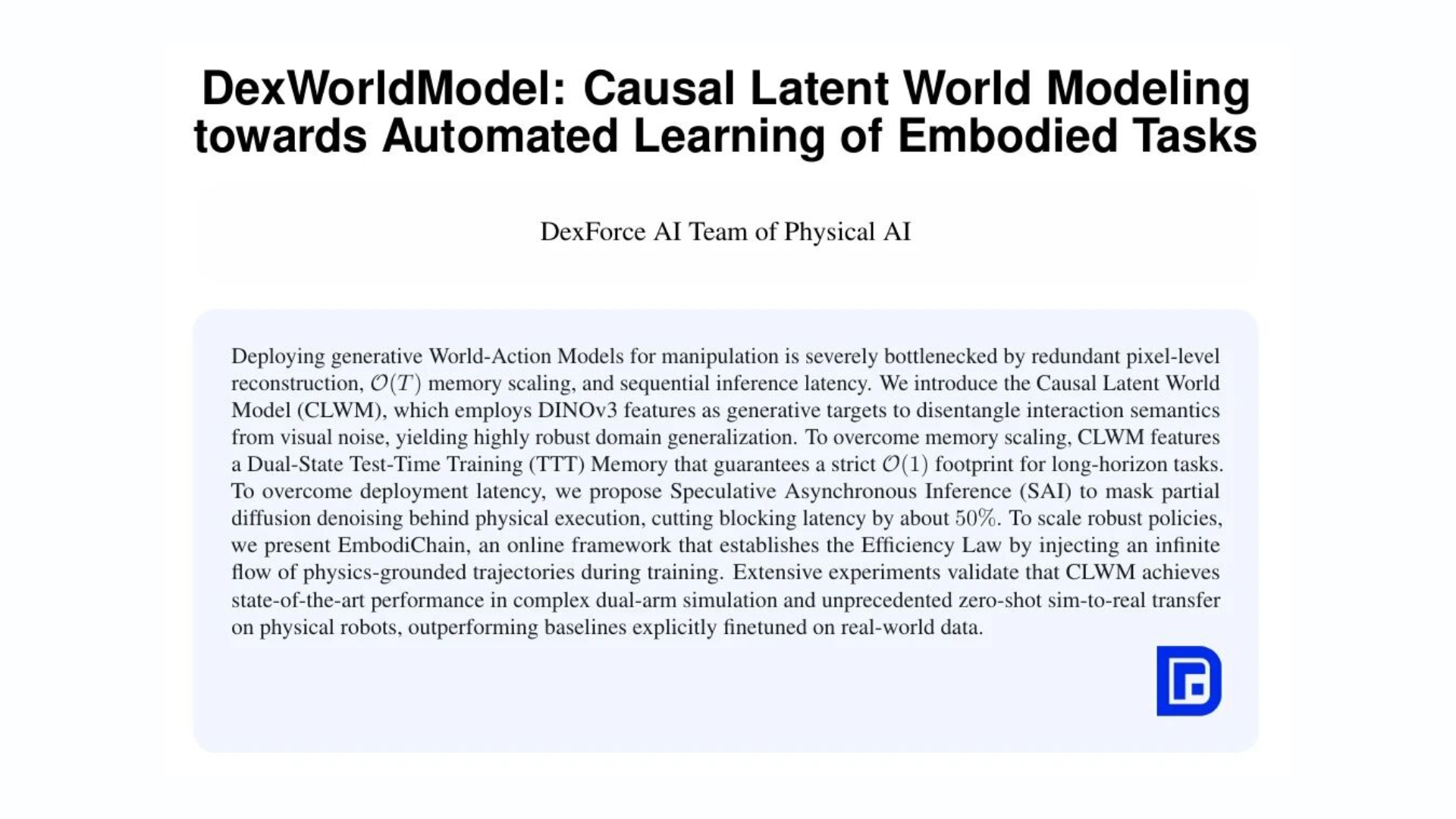
What DexWorldModel does at the system level can be simplified into one bus: Causal Latent World Model (CLWM) + Dual-State Test-Time Memory + Speculative Asynchronous Inference (SAI) + embodied data chain and online data stream (EmbodiChain / ODS)
(Download link: https://dexforce.com/docs/DexWorldModel.pdf)
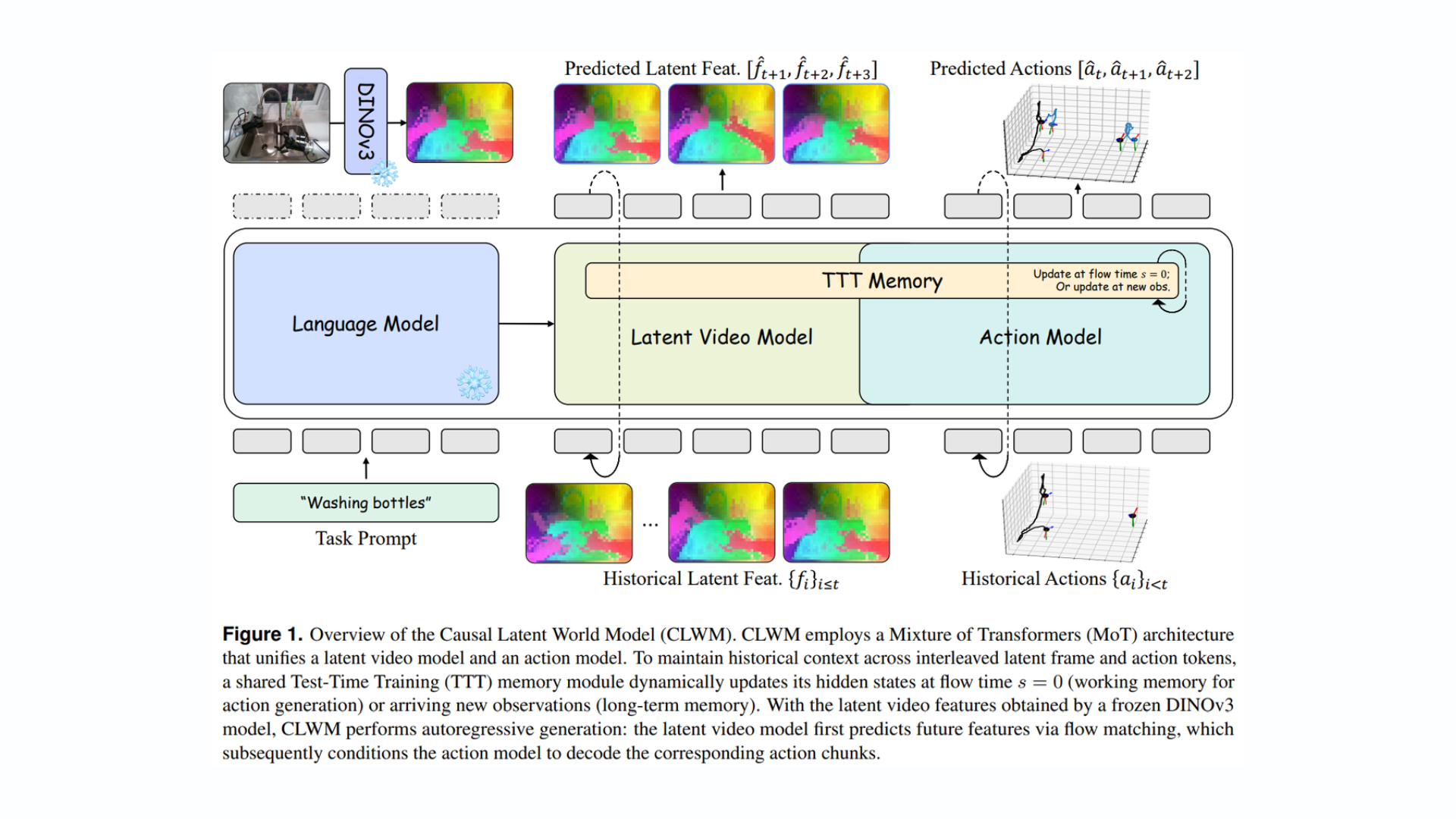
These four pieces are not four independent modules; they are coordinated upgrades made around one main line — “closed-loop deployment on real robots” — running from representation, memory, and inference to data supply, each responding to one of the four types of bottlenecks mentioned earlier.
3.1 Representation layer: why “pixel reconstruction” becomes the hidden enemy of world-model generalization
Many world models predict the future directly in pixel space or in a rather low-level visual latent space. This path is valid in research, but in real robot tasks the model has its capacity dragged away by large amounts of task-irrelevant texture, lighting, and background detail.
For a robot, what is truly critical is not whether the next frame looks realistic, but whether the world has entered a state that is operable, interactive, and ready for the next action.
The video branch and the action branch share an MoT (Mixture-of-Transformers) backbone, with independent parameterization only on the input and output projections and the Flow Matching timestep embeddings, aligning “world future rollout” and “action generation” on the same set of temporal dynamics.
This step fundamentally changes the question the world model answers: no longer “does the next frame look good”, but “has the world entered a state that is meaningful for the next action”.
It also makes it easier for the model to get across the interference of background, material, and visual noise, and is one of the foundations of the subsequent robust generalization and sim-to-real (when the model is trained with large amounts of simulation data).
3.2 Memory layer: long-horizon tasks are no longer dragged down by the ever-expanding history cache
Traditional autoregressive world models (such as DreamZero) rely on KV Cache to record history, with spatial complexity O(T): once the trajectory grows long, memory usage balloons linearly. This is not prominent in short-horizon evaluations, but in continuous, multi-step, long-duration real operations it quickly becomes the system bottleneck.
CLWM uses TTT-MLP to compress historical observations and historical actions into the weights of a memory module, and further designs a dual-state mechanism:
-Long-Term Memory: updated only with real observations and executed actions, anchoring the true causal history;
-Working Memory: forked from Long-Term Memory, serving as temporary context within the current prediction step;
-During the Flow Matching denoising process, Working Memory is frozen and is updated only after denoising is completed.
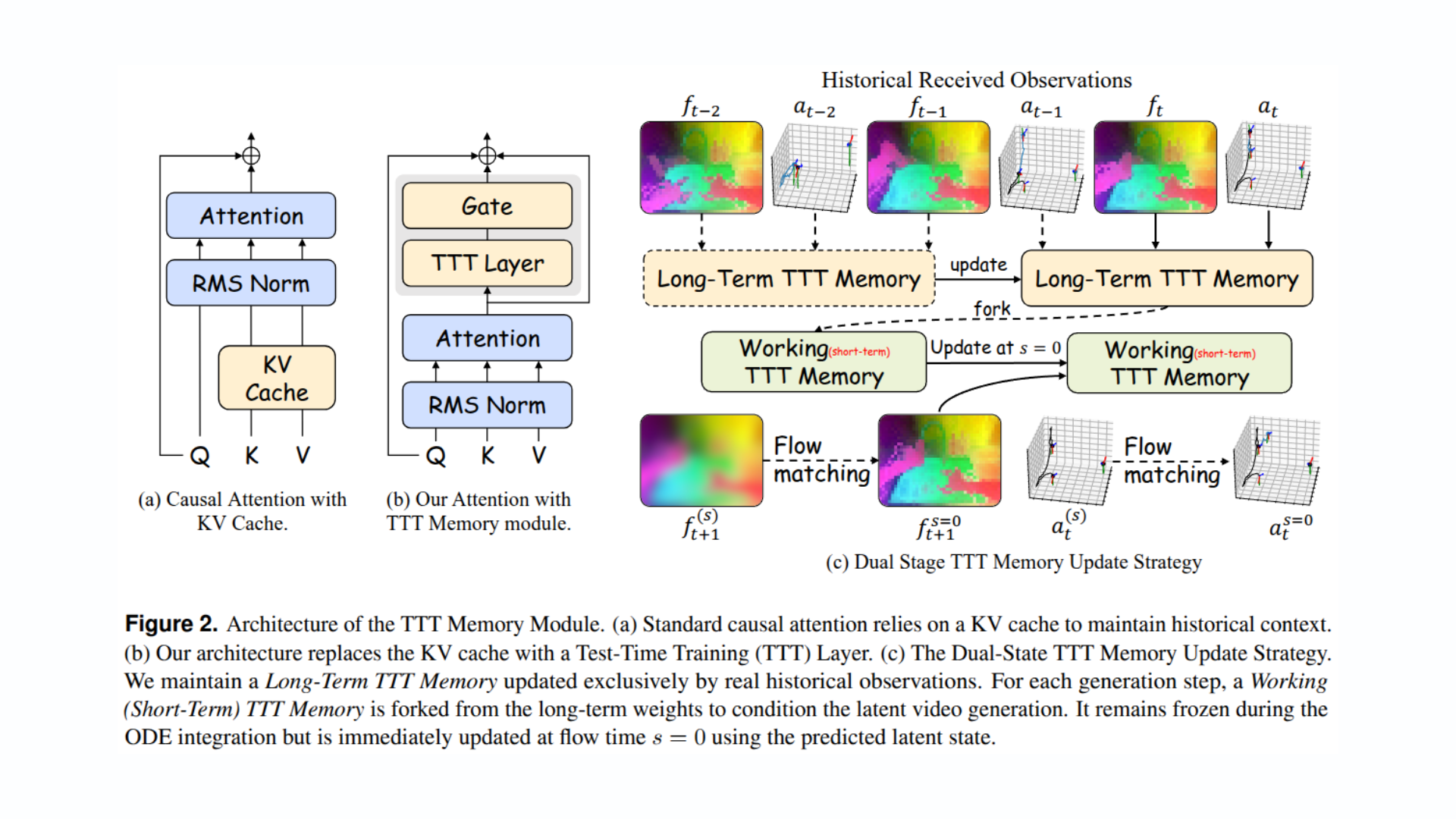
The most important thing about this mechanism is not “swapping in another cache implementation”, but strictly isolating real history from speculative history — preventing speculative futures from contaminating the true causal chain in reverse, while compressing long-horizon memory usage to a constant order O(1).
The deployment implication is also direct: the system no longer grows heavier and heavier during continuous operation, which is what gives long-duration operations a real chance at stable deployment.
3.3 Inference layer: SAI introduces the concept of pre-denoising, hiding half of the inference time inside action execution
Even if the model itself is stronger, as long as “perception → reasoning → execution” remains sequential, the closed-loop frequency on real robots will always be stuck behind blocking latency.
One truly valuable thing about a world model is that it can roll out the future; but if this foresight only stays at “the model has thought about the future internally” without changing the operating rhythm of the robot system, it is still one layer away from deployment value.
SAI (Speculative Asynchronous Inference) is precisely what converts the foresight of the model into system time at this layer:
-While the robot arm executes the current action, the GPU does not sit idle;
-Using what was obtained from the previous round of prediction as the surrogate condition, the first half of pre-denoising for the next stage of future semantics and actions is completed in the background;
-Once real observations arrive, Long-Term Memory is quickly updated, and the second half of fine denoising is completed.
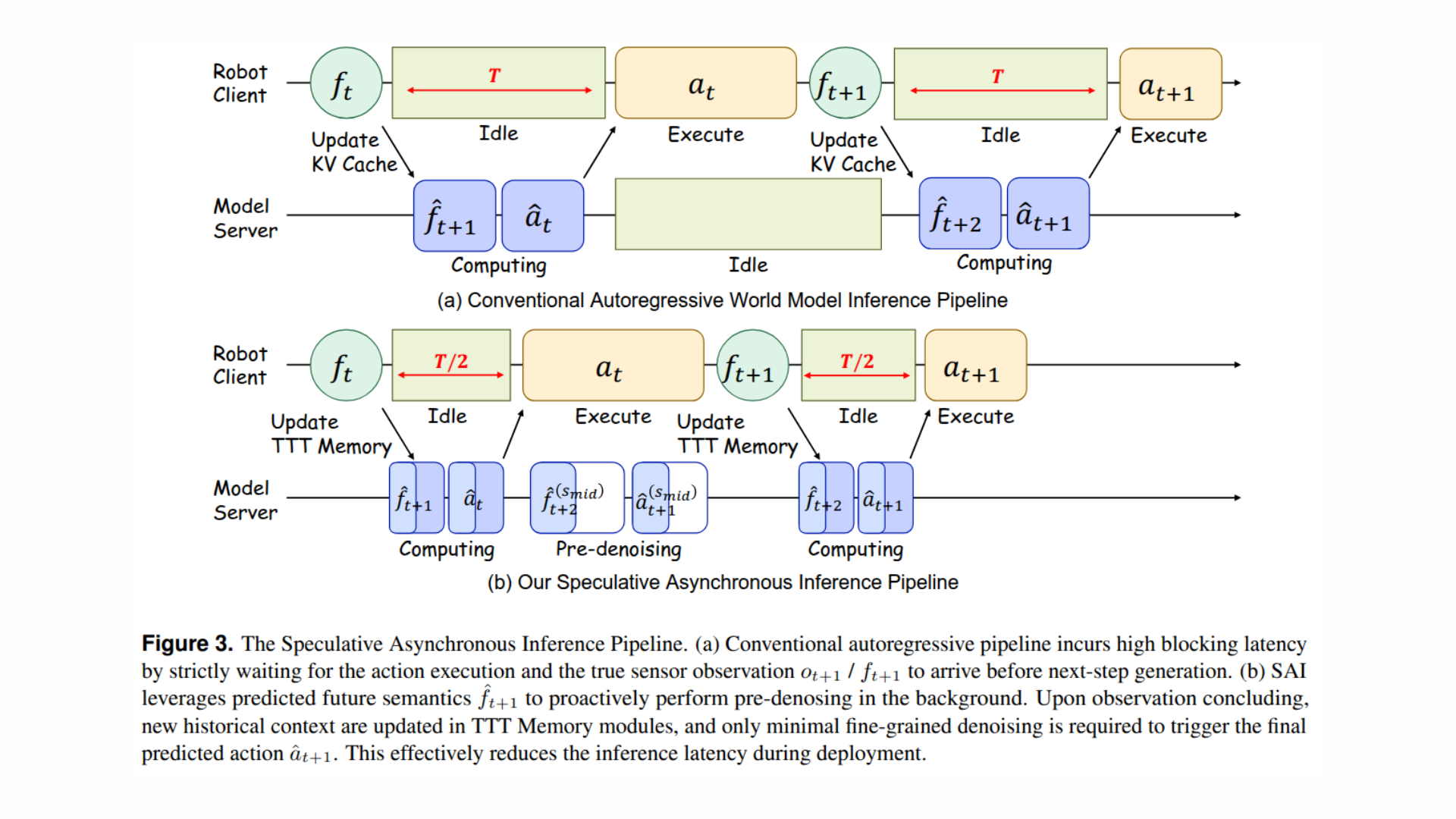
Under the RoboTwin simulation environment, end-to-end blocking latency drops by about 50%.
The change behind this is critical: in the traditional process, robot execution and model inference are strictly sequential; in DexWorldModel, these two things begin to deeply overlap.
What the world model brings is not only “better prediction”, but also “less waiting” and “higher closed-loop frequency”. For real robots, this change is often more important than simply improving a few offline metrics.
3.4 Data layer: EmbodiChain turns data efficiency into a system capability
Whether a world model can truly “grow up” depends on whether it can continuously access experience that is fresh enough, diverse enough, and physically credible enough. And this is precisely where embodied AI differs most from the pure internet-data paradigm: robot data is costly to acquire and slow to produce, and many training processes are still limited to finite static datasets.
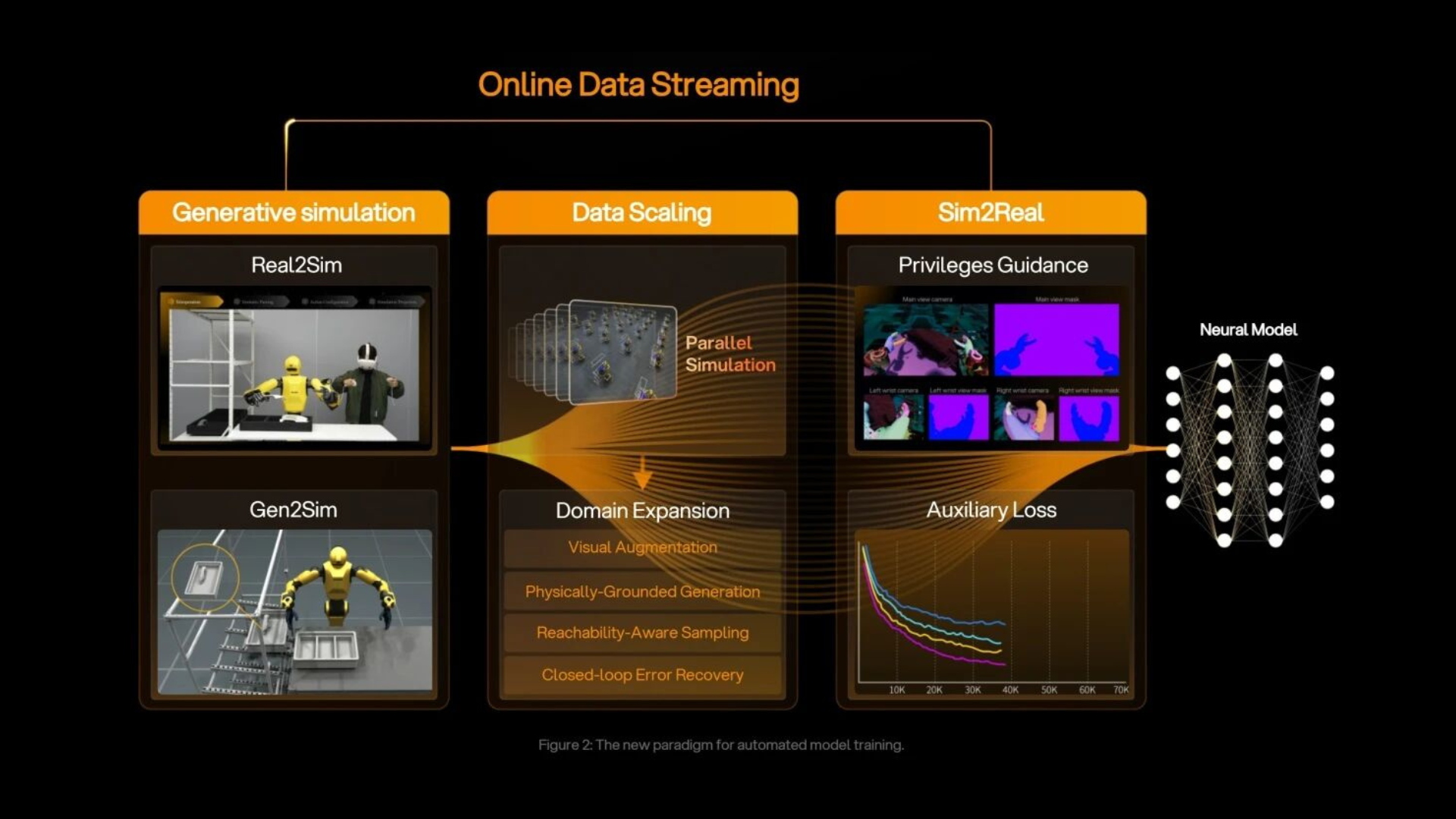
The bottleneck of robot foundation models, much of the time, is not in the network architecture but in “the throughput of high-quality interaction data”. EmbodiChain(project page: https://dexforce.com/embodichain/index.html) turns the whole chain from data production to training updates into an online closed loop:
-Rapid generation of physically consistent assets and scenes;
-Reachability-aware trajectory sampling to improve diversity at the functional level;
-Failure-recovery trajectories flowing back into training, completing the supervision signal for error states;
-ODS (Online Data Streaming): streaming new batches of data in, replacing repeated training on static datasets.
The ablation experiments in the paper also confirm this — when the throughput of fresh experience in the online data stream is higher and each trajectory is reused fewer times, the task success rate improves significantly.
So EmbodiChain is not a set of “peripheral data tools” beside DexWorldModel; it is the experience engine that allows DexWorldModel to keep approaching the capability boundary of the real world.
04 Results: First on RoboTwin Quantitative Metrics
As mentioned earlier, the place where an embodied world model should truly be evaluated is the robot task success rate. So this time we put the results directly on the truly relevant leaderboard: RoboTwin.
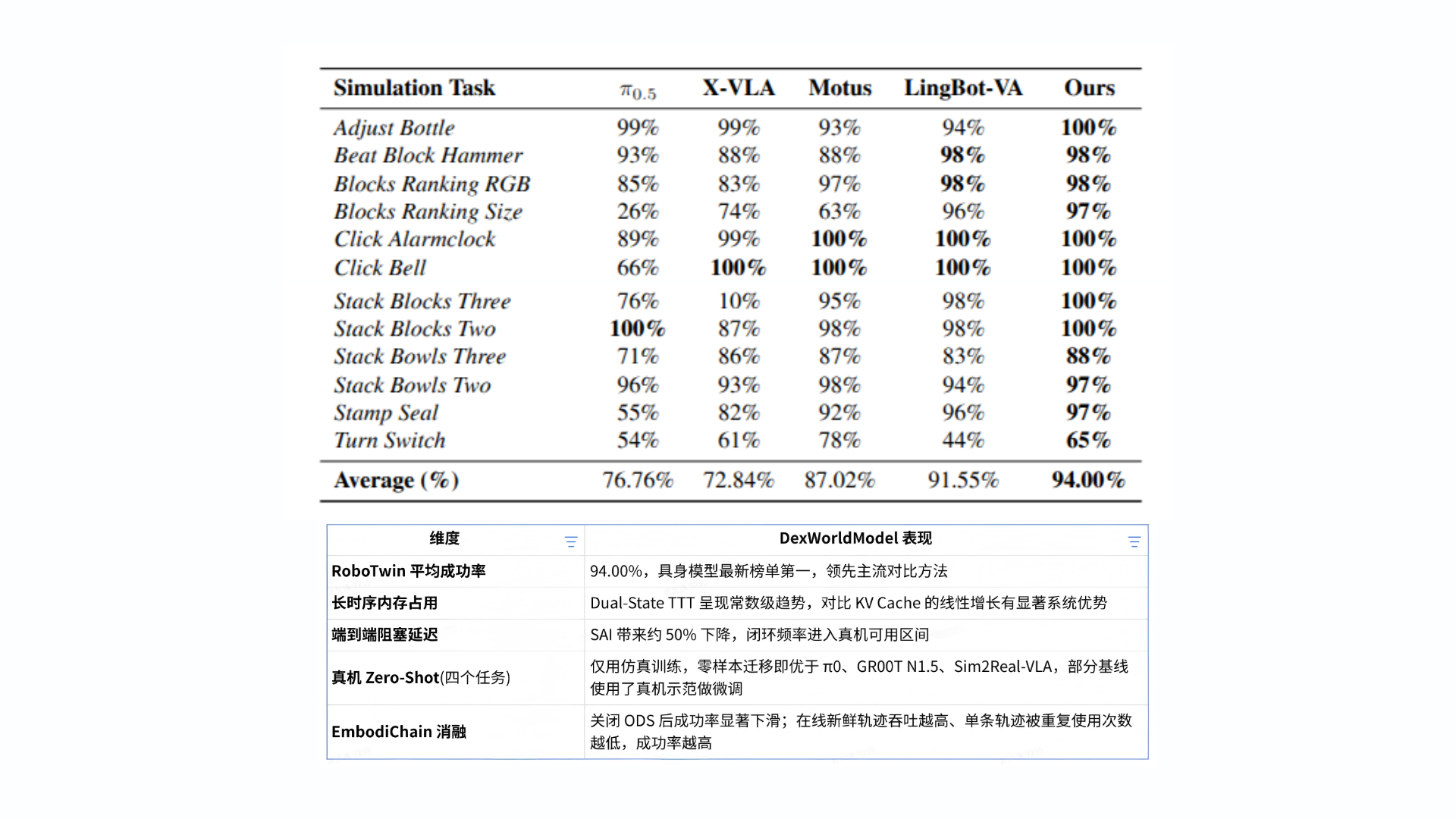
On the simulation benchmark RoboTwin, DexWorldModel achieved an average success rate of 94.00%, surpassing multiple existing baselines.
On system efficiency, two results are especially critical: Dual-State TTT Memory maintains constant memory usage in long-horizon tasks, and SAI reduces deployment blocking latency by about 50%.
Even more worth attention is the Sim2Real link. DexWorldModel reported zero-shot sim-to-real results on four real robot tasks: trained only in simulation, it outperformed π0, GR00T N1.5, and Sim2Real-VLA — some of which were even fine-tuned with real demonstrations.
Several points of this set of results deserve emphasis:
First, it is not a single-point leaderboard run, but a systemic result.CLWM solves representation, TTT solves memory, SAI solves inference rhythm, and EmbodiChain solves experience supply — the gains of the four layers stack on the same curve.
Second, EmbodiChain is not an “optional add-on” — it directly participates in raising the ceiling.In the ablation experiments, removing ODS from the process makes the success rate visibly slide. This further confirms that “the continuity of the experience stream is itself a system capability”.
Third, zero-shot Sim2Real is the most convincing slot.Training only in simulation, directly running four tasks on real robots, and surpassing some strong baselines fine-tuned with real-robot demonstrations — this is the true watershed for “whether the embodied world model path works”.
This is of course not the end point, nor does it mean the world model has crossed all deployment thresholds.
But it at least shows one thing: when the world model is systematically rebuilt around the key questions of semantic state, long-term memory, deployment rhythm, and experience supply, the distance from concept to deployment can indeed be narrowed step by step.
05 Open-Sourcing EmbodiChain: Pushing the Scaling Law Back onto the Right Variable of Embodied AI
If DexWorldModel is the answer sheet on the model side, then EmbodiChain is the infrastructure that DexForce Technology hopes to hand to the entire industry.
Over the past two years, the Scaling Law has often been cited in embodied AI.
But what the world of robotics truly lacks has never been parameters, nor stockpiled data, but a continuous, physically credible, interactive stream of data. On this variable, the entire field is still under-supplied.
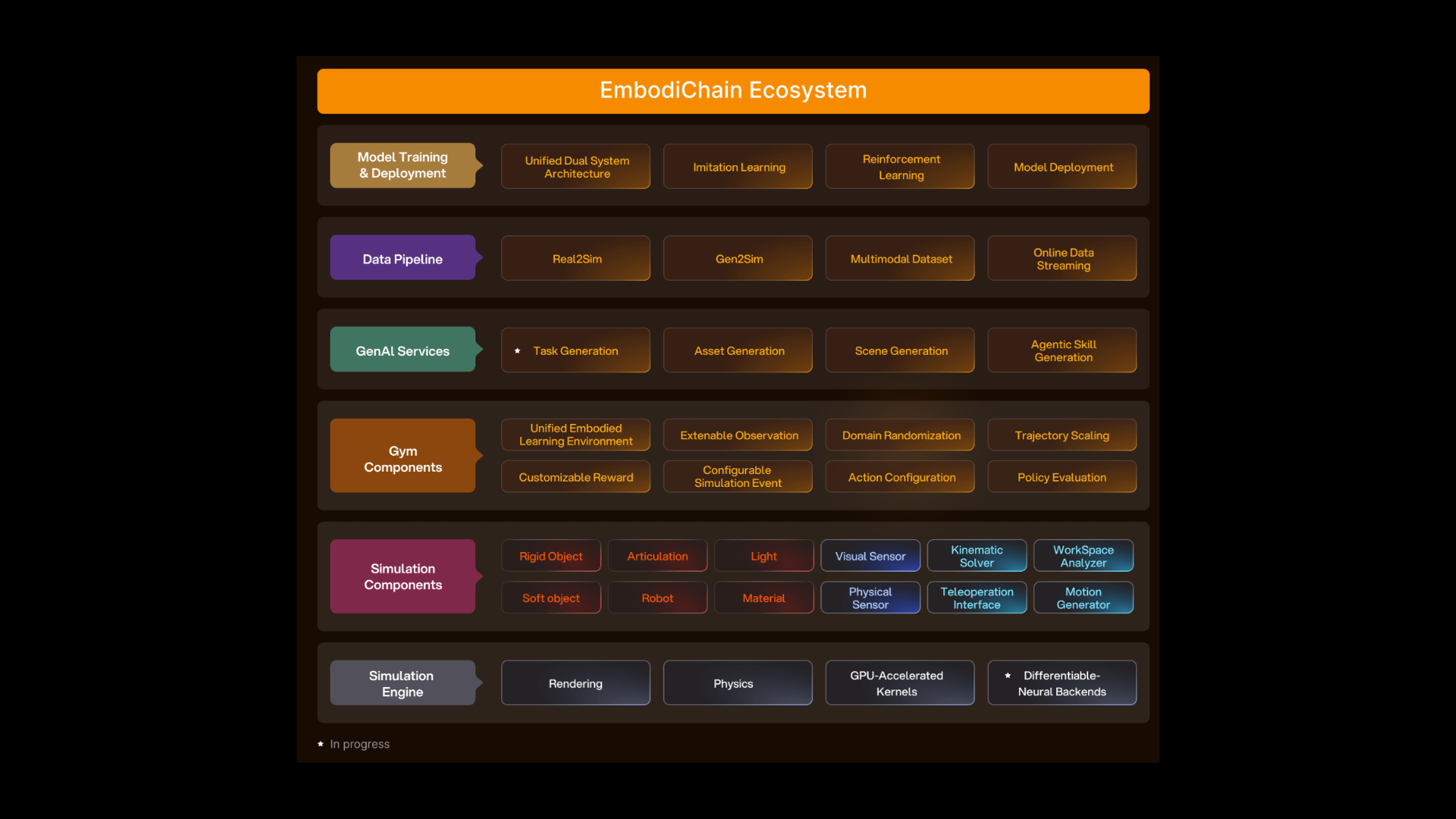
This is also why we chose to open-source EmbodiChain as simulation data infrastructure. It is not a one-off dataset release, but a complete experience-production pipeline that the community can reuse, extend, and co-build: asset generation, scene layout, reachability-aware sampling, failure recovery, visual domain expansion, and Online Data Streaming are all opened up in a modular way.
DexForce Technology hopes this can help the industry pull its attention back from “bigger models” to “more continuous, fresher, more physically credible data infrastructure” — the main axis that truly determines the scaling slope of embodied AI.
Open source is not the end point, but the way to make this curve steeper. DexForce Technology looks forward to more peers putting this infrastructure to use, and to jointly pushing it toward a more complete form.
Conclusion
To sum it up in one sentence: what DexForce Technology wants to say at this stage is actually not just “we released a world model”, but this — the decisive factor for world models lies not in whether the generated video is realistic, but in whether the robot can reliably get things done.
When the creators of VLA themselves have decided to abandon VLA — only one question remains: who can be the first to pull the road of embodied models from concept to real robots.
What DexWorldModel does is push on four layers at once — representation, memory, inference, and the data engine — narrowing the last few gaps of Sim2Real step by step; what EmbodiChain does is make this something that can keep happening. Next, DexForce Technology will keep walking the harder but more meaningful road of “real-robot leaderboards”.
The meaning behind DexWorldModel has never been only the world model itself, but the choice of DexForce to face head-on those system questions that truly determine deployment — what exactly is the nearest obstacle to real deployment today, which problems deserve to be solved first, and which system capabilities must be built first.
It does not claim that the world model has finished the road to the real world, but it has indeed narrowed several of the most critical gaps in it.
This is also the consistent attitude of DexForce Technology — race not against concepts, but against the real world.
Project page: https://dexforce.com/embodichain/index.html