
Three Papers Accepted at ICLR 2026 From the DexForce Team
ICLR 2026, the International Conference on Learning Representations, is a top-tier conference in machine learning and deep learning, spotlighting frontier research across all aspects of deep learning. It has published a large number of highly influential papers in artificial intelligence, statistics and data science, as well as in key application areas such as computer vision, speech recognition and text understanding. With broad and far-reaching international influence, the conference ranks among the leading AI conferences on the Google Scholar impact ranking, and is regarded as one of the three premier machine learning conferences alongside NeurIPS and ICML.
ICLR 2026 will be held in Rio de Janeiro, Brazil, from April 23 to 27, 2026. Recently, ICLR 2026 announced its paper acceptance results, and a total of 3 papers from the DexForce Technology team have been accepted.
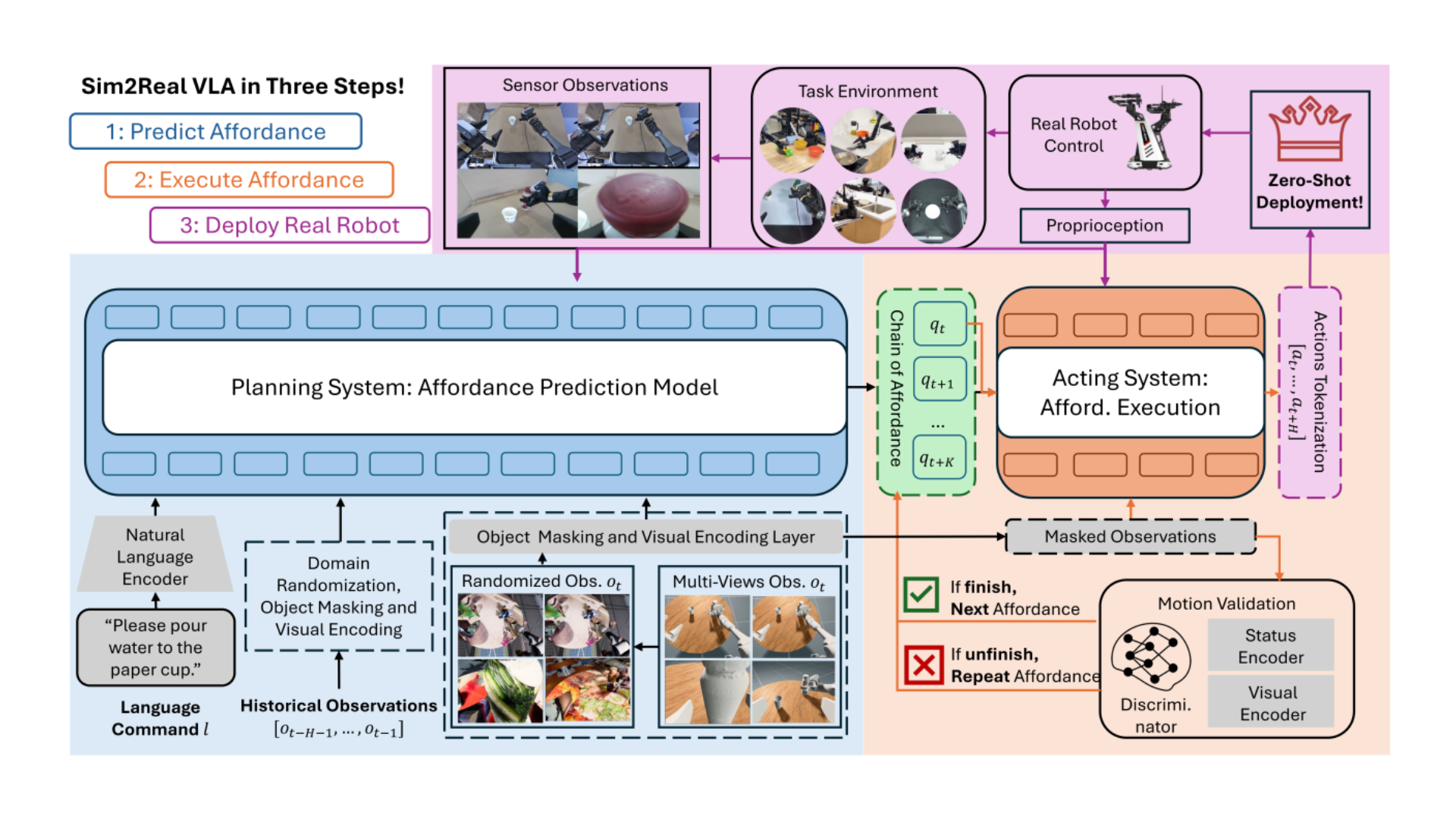
01 SIM2REAL VLA: ZERO-SHOT GENERALIZATION OF SYNTHESIZED SKILLS TO REALISTIC MANIPULATION
Authors: Runyi Zhao, Sheng Xu, Ruixing Jin, Yueci Deng, Yunxin Tai, Kui Jia, Guiliang Liu
Affiliations: CUHK-Shenzhen, DexForce Technology
Key contribution: zero-shot generalization from simulation to reality, trained without any real-world data.
Method innovation: a dual-system architecture (planner + executor) combined with automatic data generation, reducing the need for manual fine-tuning
Significance: provides a scalable and efficient Sim2Real transfer solution for robotic manipulation
Abstract: Vision-language-action (VLA) models represent a key milestone toward embodied intelligence in robotic manipulation. To support their training, recent research has developed high-performance simulation engines for data synthesis. However, their effectiveness is still markedly limited by the sim-to-real (Sim2Real) gap, as policies trained on synthesized data often fail to generalize reliably to the real world. To address this challenge, we propose Sim2Real-VLA, a general-purpose robot control model trained solely on synthetic data yet able to transfer seamlessly to real-world manipulation tasks. Sim2Real-VLA adopts a dual-system architecture: a high-level planner infers chains of affordances, while a low-level executor carries out and verifies these plans in real time through a tokenized action space. This design filters out manipulation-irrelevant features and prioritizes motion-critical dynamics, thereby strengthening Sim2Real domain transfer. A further notable advantage of Sim2Real-VLA lies in its tight integration with automatic data generation of manipulation skills, which removes the need for manual fine-tuning and enables scalable, demonstration-free training. Empirical evaluations on bimanual, dexterous and long-horizon tasks show that Sim2Real-VLA consistently outperforms previous VLA baselines across diverse real-world settings and domain shifts.
Paper link: https://openreview.net/pdf?id=H4SyKHjd4c
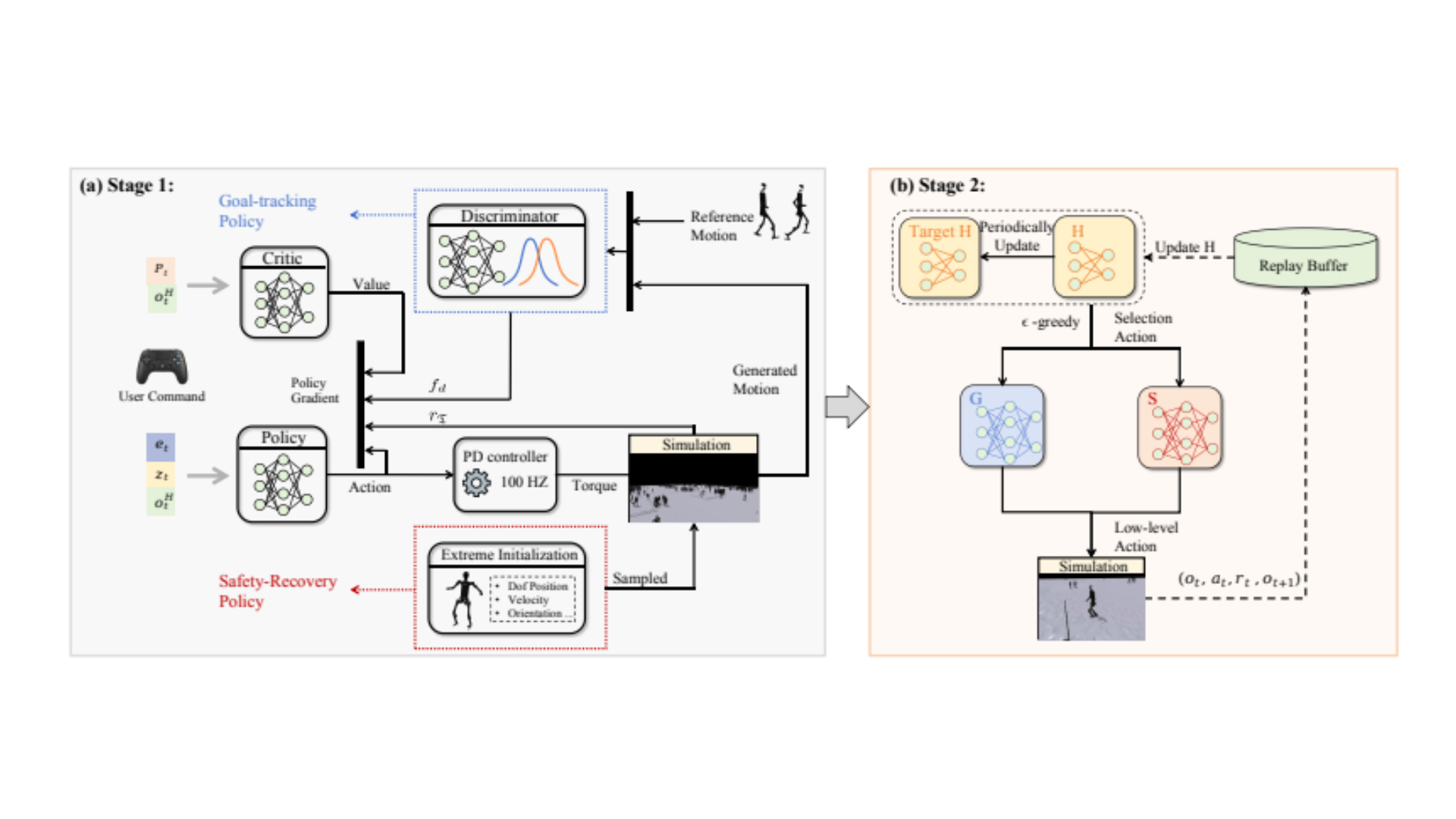
02 HWC-LOCO: A HIERARCHICAL WHOLE-BODY CONTROL APPROACH TO ROBUST HUMANOID LOCOMOTION
Authors: Sixu Lin, Guanren Qiao, Yunxin Tai, Ang Li, Kui Jia, Guiliang Liu
Affiliations: CUHK-Shenzhen, DexForce Technology
Key contribution: resolving the safety-efficiency trade-off in humanoid robot locomotion.
Method innovation: hierarchical policies (high-level planning + low-level control) combined with robust optimization to achieve dynamic recovery
Significance: advancing the practical deployment of humanoid robots in unstructured environments
Abstract: Humanoid robots, able to stand in for humans across a wide range of workplaces, have become an essential part of embodied intelligence. Yet for robots with complex physical structures, learning a control model that operates robustly in diverse environments remains inherently challenging, especially when training and deployment environments differ. This study proposes HWC-Loco, a robust whole-body control algorithm for humanoid locomotion tasks. By reformulating policy learning as a robust optimization problem, HWC-Loco explicitly learns to recover from safety-critical situations. While safety is given top priority, overly conservative behavior can undermine the ability of the robot to accomplish a given task. To resolve this challenge, HWC-Loco leverages a hierarchical policy for robust control. The policy dynamically balances the trade-off between goal tracking and safe recovery, guided by human behavioral norms and dynamic constraints. To evaluate HWC-Loco, we conducted extensive comparisons with state-of-the-art humanoid control models; the results show that HWC-Loco delivers outstanding performance in both simulated and real-world environments, across diverse terrains, robot structures and locomotion tasks.
Paper link: https://arxiv.org/abs/2503.00923
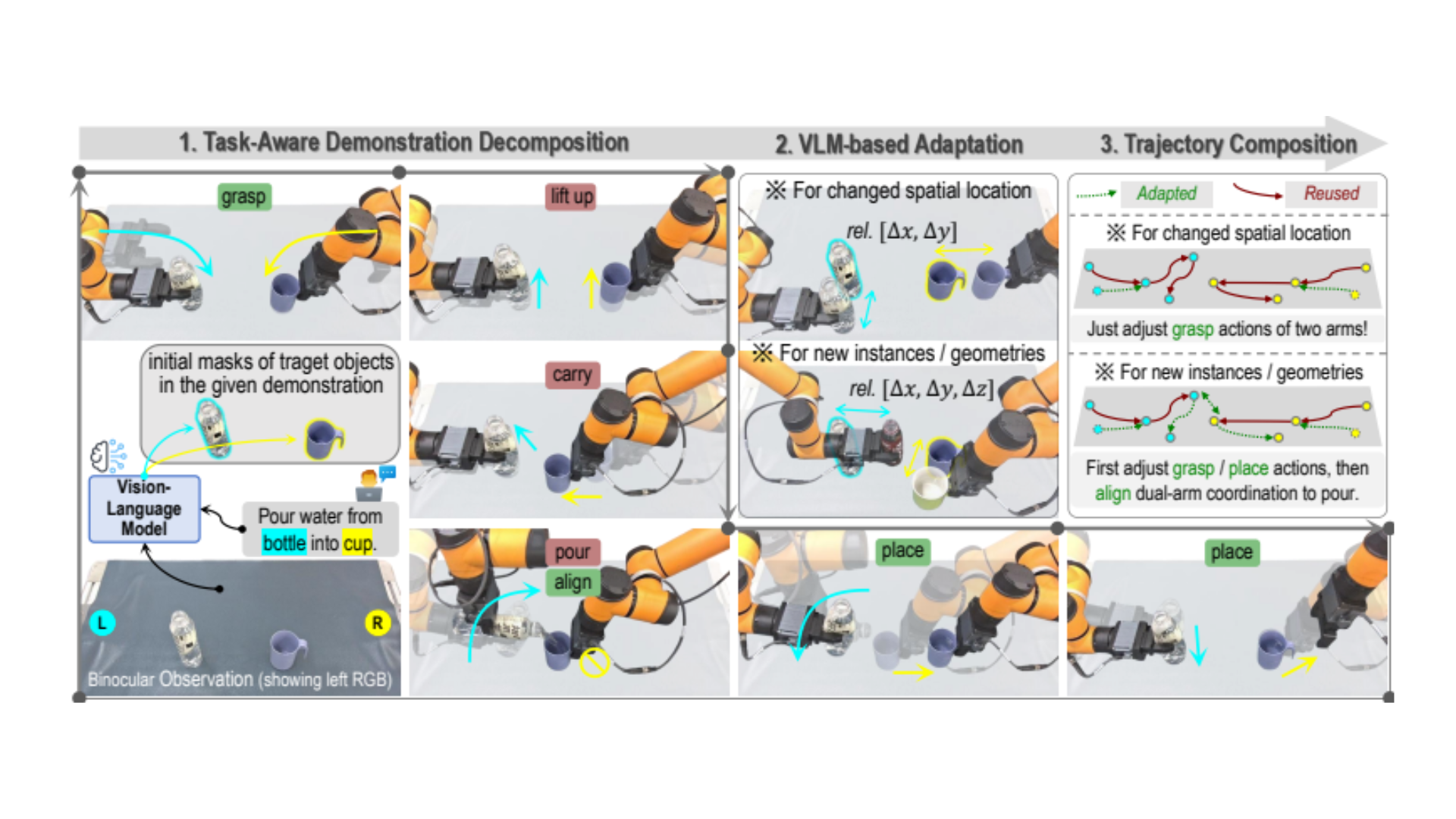
03 VLBIMAN: VISION-LANGUAGE ANCHORED ONE-SHOT DEMONSTRATION ENABLES GENERALIZABLE BIMANUAL ROBOTIC MANIPULATION
Authors: Huayi Zhou, Kui Jia
Affiliations: CUHK-Shenzhen, DexForce Technology
Key contribution: generalization to new objects, scenes and robot platforms from a single demonstration
Method innovation: a three-stage pipeline (decompose - adapt - compose) combining VLM-based perception with motion optimization
Significance: a practical and efficient solution for bimanual manipulation in unstructured environments
Abstract: Generalizable bimanual manipulation requires learning efficiently from minimal human input while adapting to real-world uncertainty and diverse robot morphologies. Existing methods face a dilemma: imitation policy learning demands extensive demonstrations to cover task variations, while modular approaches often lack flexibility in dynamic scenes. We introduce VLBiMan, a framework that acquires reusable skills through task-aware decomposition of a single human example, retaining invariant motion primitives as anchors while dynamically adapting pliant components via vision-language grounding. This adaptation mechanism resolves scene ambiguity caused by background changes, object repositioning or visual clutter without policy retraining, leveraging semantic parsing and geometric feasibility constraints. In addition, the system inherits human-like hybrid control capabilities, enabling mixed synchronized and asynchronous use of both arms. Extensive experiments on tool-use and multi-object tasks validate VLBiMan, showing that: (1) demonstration requirements are substantially reduced compared with imitation baselines; (2) compositional generalization to long-horizon tasks is achieved by assembling atomic skills; (3) robustness holds for semantically novel objects and external disturbances; and (4) strong cross-embodiment transfer indicates that skills learned from human demonstrations can be instantiated on different robot platforms without retraining. By connecting human priors with vision-language-anchored adaptation, our work takes a step toward practical and general bimanual manipulation in unstructured environments.
Paper link: https://hnuzhy.github.io/projects/VLBiMan/
The three research papers presented by the DexForce team at ICLR 2026 are not only academic breakthroughs but also a concentrated expression of its technology strategy. Sim2Real-VLA overcomes the simulation-to-reality transfer bottleneck, providing scalable foundational support for the large-scale training and validation of robot skills; HWC-Loco ensures safe and robust locomotion of complex embodiments in dynamic environments, laying a solid base for stable execution in unstructured scenes; and VLBiMan achieves rapid generalization of bimanual manipulation from a single demonstration, markedly lowering the barrier for robots to adapt to new tasks and improving usability and accessibility.
Together, these three works — spanning the simulation training foundation (Sim2Real-VLA), the embodiment control base (HWC-Loco) and the skill generalization engine (VLBiMan) — form a full-chain layout of the DexForce robotics intelligence stack, creating closed-loop capabilities from data generation and motion control through task execution.
Going forward, the DexForce team will keep pushing deeper into embodied AI, using technological innovation as its engine to accelerate the large-scale application of robotics in complex scenarios such as intelligent manufacturing and commercial services, and injecting solid momentum into the arrival of the era of general-purpose robots.