
Talk to Prof. Jia Kui: On the Next Decade of Physical AGI
In 2016, Prof. Kui Jia returned to China after finishing his overseas studies and devoted himself to computer vision research. At the time, a flood of talent was pouring into face recognition and image understanding, yet he turned instead toward a direction almost no one had explored.
Over the following five years, he kept asking two deceptively simple questions: What is the essence of 3D data? And how should Physical AGI be defined? In his view, these explorations unfolding around the three-dimensional world were the real core propositions.
Choosing an unpopular direction also meant paying the price of grinding away in obscurity for years.
During those waiting years, he ran model derivations over and over, verified hypotheses again and again, and kept rebuilding his own understanding of the world, yet he almost never wavered. “If what you do is what you love, why would you switch?” That is his criterion for judging whether a person is lucky — simple to the point of plainness.
His understanding of the world model carries the same almost instinctive accuracy.
He believes the reason Physical AGI is called physical artificial general intelligence is that it must truly enter the physical world and ultimately land on a concrete intelligent terminal.
People observe the world from different perspectives, and what they see are merely so many mirror images of reality. When countless partial, scattered pieces of information are layered together, the world appears immensely complicated. But in the eyes of Prof. Jia, the physical world is simple. If you can reach its true underlying mechanism, it becomes as light as Einstein’s E=mc². Only by finding such essential laws can one build a truly scientific world model.
At the end of 2025, DexForce Technology open-sourced its core technology EmbodiChain — an online data stream and model production line that realizes virtual physical models trained entirely on 100% generative synthetic data. In this world, where AI learns the essential laws of the physical world, the environment, the objects, and the robot body itself can all keep evolving.
There is more than one path to the destination. DexForce has chosen the longer-horizon road: first create the “world”, then let AI go deep into every corner of the physical world, and ultimately build a sustainable road towards Physical AGI.
The Road to Physical AGI
Q1) Could you start by introducing yourself and what DexForce is working on now?
Prof. Kui Jia:Since its founding in 2021, DexForce Technology has been dedicated to solving the interaction between AI and the three-dimensional physical world.
I began researching computer vision in 2001. Starting in 2016, I have been exploring how to use AI for 3D modeling and generation, and how to train models with synthetic data to drive robots through dexterous manipulation tasks.
A key technical milestone came in 2019, when we published an end-to-end model capable of precisely grasping unknown objects, trained purely on mixed data. This body of accumulated technology laid the groundwork for preparing to found the company in 2020, when ZhenFund also joined as an angel investor.
In recent years, with the rise of Physical AI and the boost of large models, the underlying technology, products, and business of DexForce have gone through a cycle from steady to accelerating growth. Today, we have gradually formed a multi-dimensional, synergistic product matrix: the DexVerse™ engine as the technology base, paired with KINGFISHER vision sensors, the DexForce W1 humanoid robot body, and PickWiz robot brain software.
To return to the core belief of DexForce: Develop a sustainable road towards Physical AGI. We hope to forge a sustainable path, using continuous original technology to push AI deep into every corner of the physical world and create real value across different industries.
Q2) How do you understand Physical AI at present, and what has changed for you along the way of building the company?
Prof. Kui Jia:I have always believed that Physical AI is something to be advanced through practice. Only by constantly building technology and products can you truly get close to it. The human being is a quintessential advanced biological agent. The relationship between human cognitive intelligence and bodily form corresponds exactly to the relationship between today’s large language models and Physical AGI.
From the technical side, we still follow the AI paradigm supported by massive data, large models, and strong compute. This paradigm has benefited from the text, images, and video accumulated on the internet since the 1990s, which is why large language models and multimodal models made rapid gains between 2022 and 2025.
But Physical AGI is a proposition for the next decade, or even longer. Its demand on data is not merely an increase in quantity, but a fundamental change in the paradigm of how data is produced.
The fundamental data ingredients for achieving Physical AGI may come from data collection by real robots, or via video generation, or via frontier paradigms such as the 3D generative technology and Generative Simulation our team excels at.
On the other hand, Physical AI must land on actual agents and run in real application scenarios such as homes and factories. This in turn places different functional demands on the end-side agent.
From both the technical and the application perspective, Physical AGI is harder than the large models and AI Agent applications people see today. But its ceiling is higher, its room for imagination is greater, and its pull on the whole socio-economy and on human behavior is stronger.
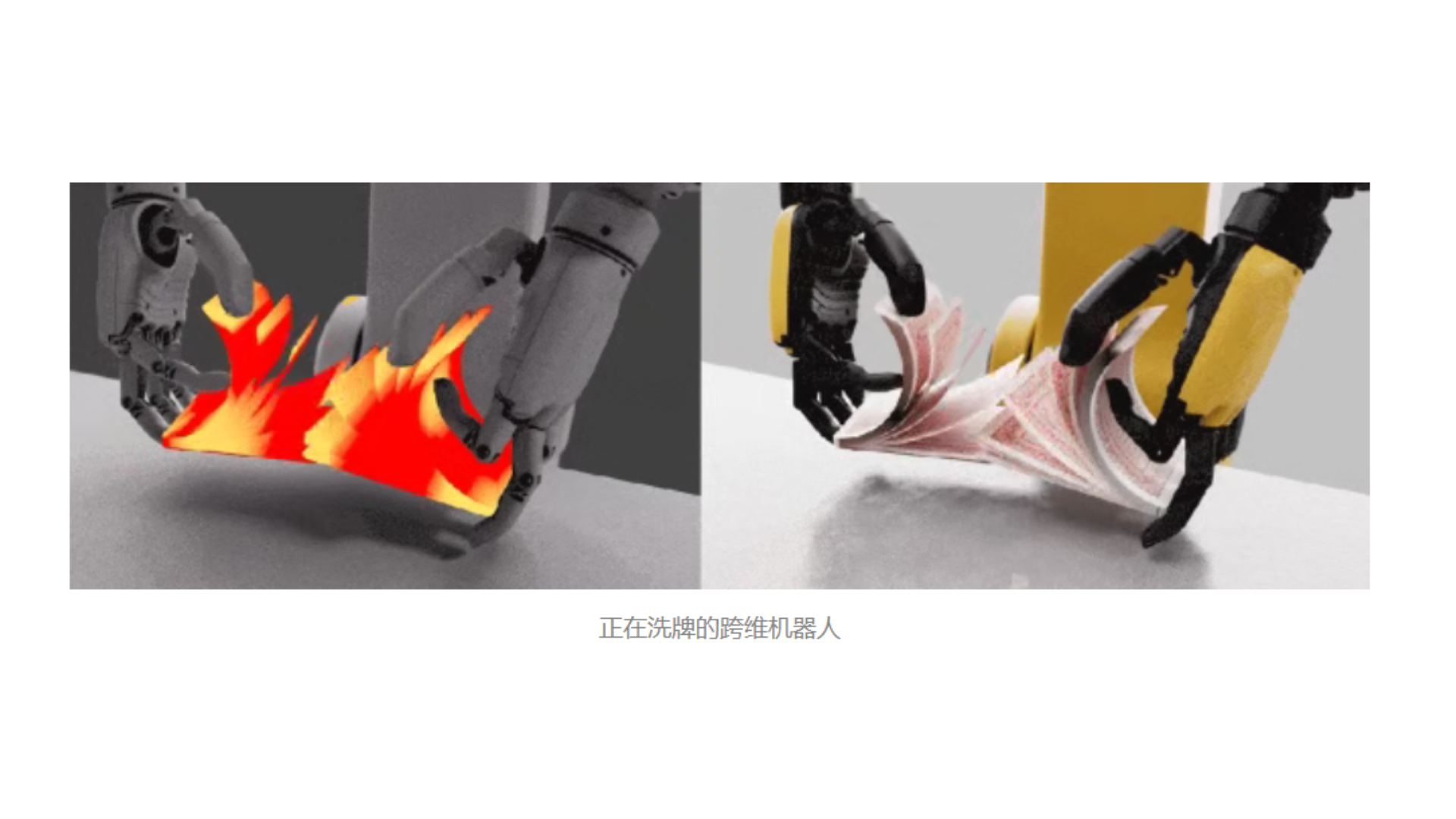
Q3) What considerations went into designing the embodiment of the DexForce humanoid robot?
Prof. Kui Jia:The reason Physical AGI is called physical artificial general intelligence is that, at its core, it must enter the physical world and ultimately land on a concrete intelligent terminal.
The form of that terminal, in turn, is determined by the first principles of its application scenario. For a robot working in a factory, a humanoid form is not a must; what matters is whether it can complete the assigned tasks stably and with high precision.
In some commercial service scenarios, the evolutionary path of robots becomes more human-like. In social life or commercial service, people are building their own IP and persona, because what you sell is not merely functionality but also brand value. If we look beyond digital humans and observe the real people existing in the physical world, we will find that building a robot IP that generates derivative value in itself is extremely important.
As for the home scenario, people have multi-dimensional demands for robots. First is solving real housework — for example, we hope it can tidy up the shoe cabinet after work, or, when there are small children at home, put away the toys scattered across the floor. This is the demand for its tool attributes.
But once the robot takes a humanoid form, people will have a higher demand for companionship.That companionship covers verbal communication, emotional exchange, and even whether the look is cute and whether it feels warm. This is why some researchers today specialize in “warm” robots, or pursue ultimate aesthetics in appearance design.
If you want to build a deep product that both solves real problems and interacts positively with people, balancing appearance design and interaction logic is essential.
Building the World Model
Q4) How do you view the several different data collection approaches today?
Prof. Kui Jia:The industry generally hopes that the Scaling Law observed in large language models will also appear in Physical AI. But there is a precondition: without data at a sufficient scale, simply increasing model size or compute means little. Therefore, the primary question embodied AI faces today is how to improve the efficiency of data production.
Between 2024 and 2025, the industry gradually formed a consensus: build data-collection sites and use real-robot teleoperation to obtain training data. But the efficiency of this approach remains limited. More efficient embodiment-based collection schemes such as UMI (Universal Manipulation Interface) later appeared, though how strong a model this path can actually train still awaits verification.
Another path carrying high hopes is video generation. Models like Sora have already shown powerful capabilities in content creation, but the essence of video generation is a two-dimensional result. In terms of technical paradigm, diffusion-based video generation is still modeling in RGB pixel space, lacking an explicit physical causal structure. This means it is difficult for it to meet rigorous engineering standards in precision, stability, and physical consistency.
Our goal is, on the one hand, to fully exploit the generation efficiency brought by models and compute, and on the other hand, to ensure the generated content carries strict 3D physical realism.Around this point we also conducted rigorous proof-of-principle validation. The results proved that a model trained entirely on 100% generative synthetic data can indeed work in real applications.
What we should really pay attention to is not the merits of any single data acquisition method itself, but which data paradigm can truly set the Scaling Law of large AI models in motion.
Q5) How did you feel when Sora was released?
Prof. Jia:One key message surrounding the Sora release was the world model.
But the concept of the world model was proposed in the reinforcement learning field as early as 2018. Its core logic is that to perform efficient reinforcement learning, a system must possess an internal model that simulates the world, so as to learn and produce excellent policies. Although this idea had long existed in academia, it had never gone mainstream before.
What makes Sora stunning is that its generated videos far surpass the past in appearance, dynamics, and scene expressiveness, but it still learns diffusion models within RGB pixel space. OpenAI tried to argue: if our model were not a world model, how could it produce such realistic video results?
The model required by Physical AI serves not the eyes of humans but concrete task execution — for example, how a robot can precisely pick up a cup of coffee and hand it to you.
This is completely different from mere two-dimensional visual appearance. Anyone with basic machine learning or engineering knowledge understands that a 2D image is only a projection of the 3D world from a specific viewpoint, which means information is inevitably lost in the projection. The generated video looks exquisite, but once the viewpoint switches, it often exposes large amounts of distortion.
Current video-generation vision models fundamentally cannot solve the problems of 3D shape accuracy, physical accuracy, and dynamic causal accuracy in their generated results.
Q6) Where does the world model currently stand in its progress?
Prof. Jia:This is a goal everyone wants to achieve. But as to how exactly, I think the question must first be thought through clearly. The industry still lacks a commonly accepted and precise definition of “what a world model is”.
While the definition is not yet unified, people can only judge by results whether a model truly possesses the capability of a world model. If your model is a world model, it should always be able to avoid obstacles accurately and plan paths in autonomous driving scenarios; in robotic operations, it should also complete grasping and manipulation precisely and stably.
Q7) What is the advantage of DexForce in realizing the world model?
Prof. Jia:Our world model guarantees absolute 3D stability from the underlying logic of how the AI architecture does its modeling. Seen from the perspective of statistics or mathematics, this physical world is remarkably simple.
Why does everyone find it complicated, then? Because we observe the world through different viewpoints, including human eyes and various perception sensors, and these observations are only mirrors of the real world. What these mirrors provide is often one-sided information; when countless one-sided and trivial pieces of information intertwine, they create the illusion that the world is extremely complicated.
In reality, if you can reach the true mechanism inherent in the world, it is as simple and clear as Einstein’s E=mc^2. Only after finding such truly correct and concise essential laws can you build a truly scientific worldview.
Our core logic is precisely to have AI learn such essential laws, rather than crudely piling up training with massive video.Because massive amounts of video are essentially just overlays of scenes from different viewpoints: inefficient to learn from, and unable to fundamentally guarantee 3D physical accuracy.
It is not that other teams cannot do this — nearly every team in the industry emphasizes the importance of 3D physics and is trying to push in that direction. The advantage of our team lies in the fields of Neural 3D Modeling and Neural 3D Generation — the technical route of using AI for 3D physical modeling and generation — where we have consistently held an industry-leading position.
Q8) Could you briefly talk about the recent open-source work of DexForce?
Prof. Jia:The EmbodiChain data generation pipeline we open-sourced directly answers why data production efficiency matters so much.
In GS-World, we proposed the Efficiency Law at the outset, which is the precondition of the Scaling Law. Only when data production efficiency meets specific conditions can model performance keep improving.
It then describes how to rigorously construct a three-dimensional virtual world that follows physical laws in a generative way. In this world, we can efficiently generate environments, manipulation objects, and even robot bodies. Robots can produce data by working in this controllable virtual space, which then forms models and even achieves the evolution of the embodiment itself.
This is not only a concrete academic achievement but also a piece of our technology roadmap.
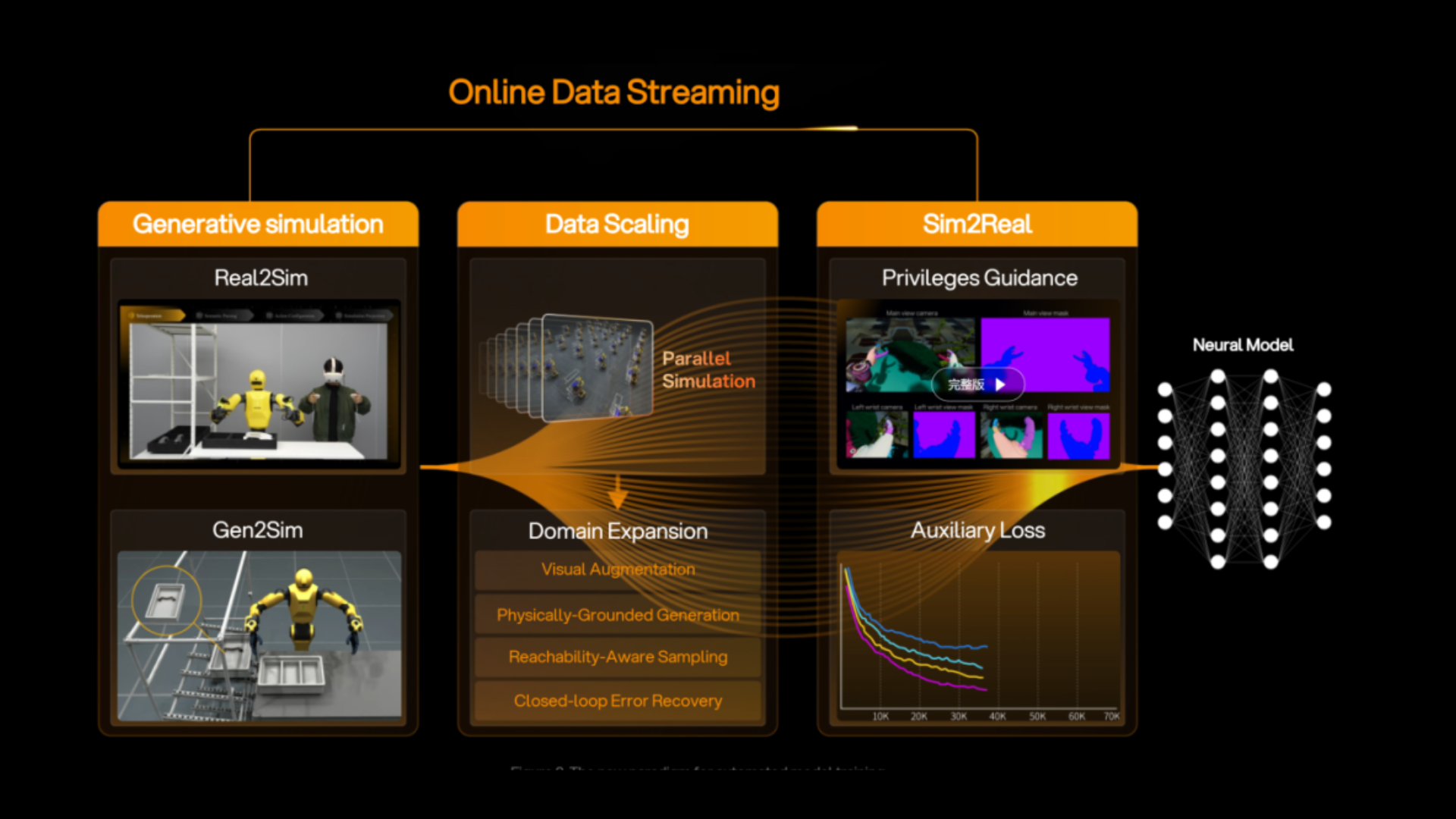
On this basis, we designed an architecture capable of realizing the Efficiency Law. This is first of all a simulation-to-reality process. Whether through real-robot teleoperation and UMI-style methods, or by directly recording videos of human operation, we can extract three-dimensional logical motions from them and project them into the virtual world. We then carry out efficient data augmentation and reinforcement learning in the virtual world. This paradigm can generate both precise 3D physical models and motion policies.
We also conducted rigorous comparative tests on the open-source Motion dataset. The results show that this paradigm clearly outperforms mainstream models such as NVIDIA’s GR00T and RDT in efficiency and success rate. As we have released, DexForce Technology has indeed achieved a VLA model trained entirely with 100% generated synthetic data. This is unique worldwide.
We believe the correct logic is that you must first send in a valuable robot and get it running to serve customers and generate value.
Following the practice of autonomous driving, we switch on “shadow mode” to let data flow back. What flows back in this mode is high-quality, annotated, anomaly-filtered data that can directly improve model performance. At this point, the robot is already working in a real environment and generating revenue, and acquiring data is just something completed along the way. This is the data-flywheel paradigm in which products and services evolve efficiently.
Through the “Quiet Grinding Years”
Q9) What first turned your attention to the world model?
Prof. Kui Jia:What drew me to this field back then was that what I cared about was the essence of AI signals. Looking back at 2015, far too many people were crowding into face recognition and image understanding, while I would ask: what is the essence of 3D data? And what is the essence of a signal? For someone doing innovative research, the most basic requirement is to absolutely never follow the crowd. If something is already being done by many people, it should not be your first choice. A researcher must follow first principles rather than echo what others say.
In that stage where no one had set foot, these explorations of the 3D dimension were the more essential and more important questions in the field of AI — innovations I believed to be truly valuable. The ability to do independent research is, in fact, a basic element that every mature PhD should possess during professional training.
Of course, this persistence comes at a price. Research can certainly originate from curiosity, but on top of curiosity you also need a touch of “utilitarian” thinking: can this curiosity ultimately produce value? Short-term, mid-term, or long-term value — you must reason it out.
The price of choosing a non-mainstream direction is that you may need to spend a long time grinding away in obscurity. Looking at the history of AI from the 1950s to today, it has gone through several rounds of peaks and troughs; even the godfather of AI, Geoffrey Hinton, went through an extremely long stretch of quiet grinding years.
One must hold on to one’s own convictions.
Q10) When have you had that feeling of grinding away in obscurity?
Prof. Jia:From 2016 to 2021, frankly, the sense of achievement I gained was far less than what those working on image understanding earned.
In academia, the citation count of your papers depends to a large extent on the base of people researching the question. If only 1,000 people worldwide pay attention to a certain 3D task while 1 million work on image understanding, then no matter how well the research is done, it cannot match hot directions on absolute impact metrics. For as long as five years, this gap existed objectively.
But even during that period, I never thought about switching direction. I feel that the criterion for judging whether a person is lucky lies in whether he is doing what he truly loves. If what you do is what you love, why would you switch?
At the time, I still firmly believed that the research I was doing held greater value — the same logic as my judgment of Physical AGI today.
From the perspective of company growth and entrepreneurship, the ceiling of Physical AGI is even higher than that of today’s large-model vendors.
Q11) What is the difference between research and entrepreneurship?
Prof. Jia:Research innovation and entrepreneurship are different forms of value creation and realization. From the perspective of research innovation, you immerse yourself in deep study, expecting that logically sound research will eventually produce value, but the results still often stay on paper, and this interaction is relatively reserved and indirect.
By contrast, entrepreneurship means working backward, in a down-to-earth way, from commercial value.To realize true value, what products or services do we need? Which technologies need breakthroughs, and are the conditions in place? How long is the breakthrough cycle? Under this logic, we also need to think about the core strengths of the team, its differentiated character, and whether it can truly generate value in the target business scenarios.
This shift in mindset allows us to shed certain research habits during innovation. We will not do things just to publish papers, nor will we do research that looks valuable but actually cannot make a real commercial contribution.
When your product gets used in real scenarios, that sense of achievement is completely different from merely pursuing paper citations. This kind of value creation is more direct and can genuinely be reflected at every level of society, whether the impact is big or small.
Returning to the Essence of Labor
Q12) Are there any concrete collaboration cases you can share?
Prof. Kui Jia:We have accumulated extensive experience in relatively semi-structured scenarios such as industry and logistics, and some projects have been running for over two years. We are not simply promoting the DexForce robot brand; we are deeply embedding robots into the business processes of franchise stores, brand owners, and shopping malls.
Making other people’s businesses run better is the true value of this humanoid robot.
One case is our collaboration with Weixiaofan. Weixiaofan is a healthy-eating brand in Shenzhen and Hong Kong that marks calories on every boxed meal. Our robots are deployed in Weixiaofan stores, taking on sales guidance and other tasks. This combination of “healthy eating + frontier technology” is both a highly attractive commercial hook and a practice of robots creating value in a real business environment.

Q13) Where does the differentiation of DexForce products lie?
Prof. Kui Jia:The core is not sheer technical level, but who can truly close the loop from technology to niche commercial scenarios. Just like face recognition technology, almost any company today can own technology with a high enough success rate, but the ultimate winners are those that have formed brand recognition and taken the market. Of course, if the demand for robots becomes extremely large in the future, the priority between their functional value and added value may change.
Q14) What is next for DexForce?
Prof. Jia:Our business philosophy can be summarized in one phrase: DexBot Inside.
The phrase borrows from the famous “Intel Inside” slogan of Intel. As a humanoid robot, even if it can attract traffic and carry IP attributes in commercial service scenarios, it must ultimately return to the essence of labor.
In interactions between people, the initial novelty can fade within two weeks, and this is even more true for robots. If a robot cannot produce real labor value, its IP and cute appearance cannot support its lasting commercial existence. In stores and other real scenarios, it will eventually regress from a novelty back to the essence of a laborer.