
Physical Token Economics, Unpacked at WRC 2026
On August 19, during the World Robot Conference (WRC 2026), the “Physical AI Leaders Forum”, hosted by DexForce Technology and co-organized by Caijing magazine, was held in Beijing.
Under the theme “Physical AI in Progress”, the forum brought together Prof. Kui Jia, founder and CEO of DexForce Technology and professor at CUHK-Shenzhen; Tao Mei, founder and CEO of HiDream.ai and foreign member of the Canadian Academy of Engineering; Xiaogang Wang, chairman of ACE Robotics and co-founder of SenseTime; Hang Su, associate researcher at the Department of Computer Science and Technology, Tsinghua University; Guiliang Liu, dual-appointed assistant professor at CUHK-Shenzhen and the Shenzhen Hetao Academy; and algorithm and technology leads from D-Robotics, AGILINK, BeingBeyond and other companies. Focusing on key links such as data, models, simulation, real-world deployment and commercialization, they explored together the technical evolution and industrial path of general physical intelligence.
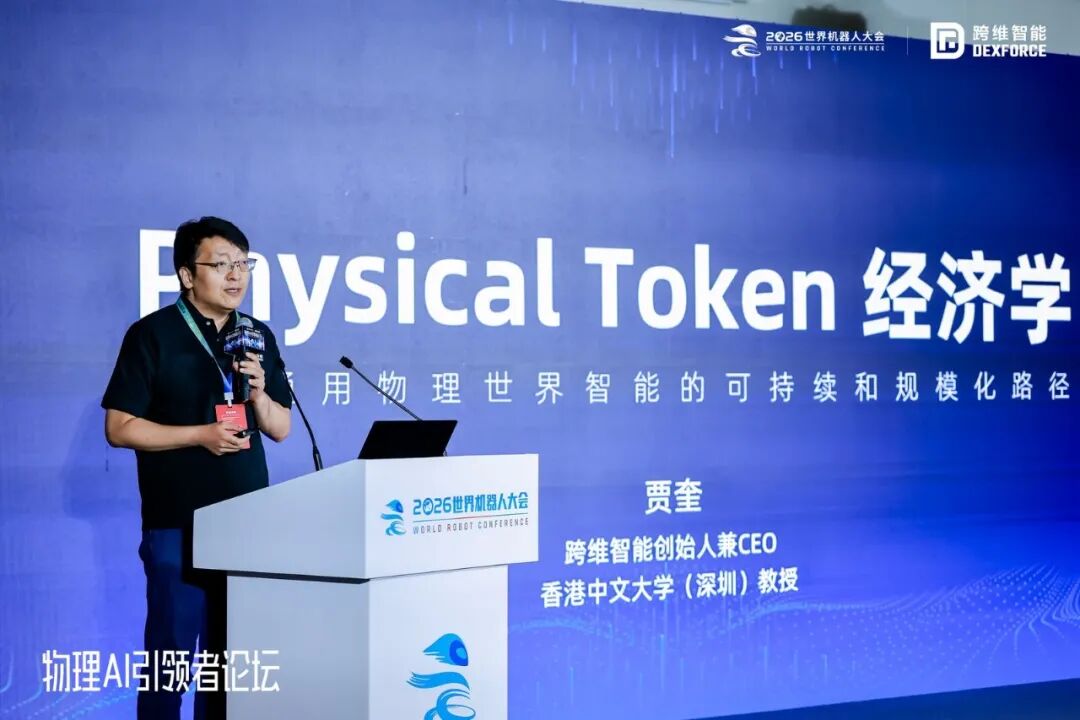
At the forum, Prof. Kui Jia, founder and CEO of DexForce Technology and professor at CUHK-Shenzhen, delivered a keynote speech titled “Physical Token Economics”. He began with the output and cost of physical intelligence: as AI moves from digital space into the physical world, what counts as one unit of reliable intelligent output? How much human labor, data and computing power must be invested for a robot to acquire a new capability? And as the system keeps learning and being deployed, can this incremental cost keep coming down?
These questions point to a fundamental yet very real proposition in scaling Physical AI: if a robot has to reinvest roughly the same resources every time it enters a new scene, learns a new skill or adapts to a new embodiment, then this is merely “project replication”, not economies of scale. What truly needs to be built is a system that can continuously produce reliable physical intelligence while steadily bringing down the cost of acquiring the next capability.
01 From Token to Physical Token: Metering Physical Intelligence Anew
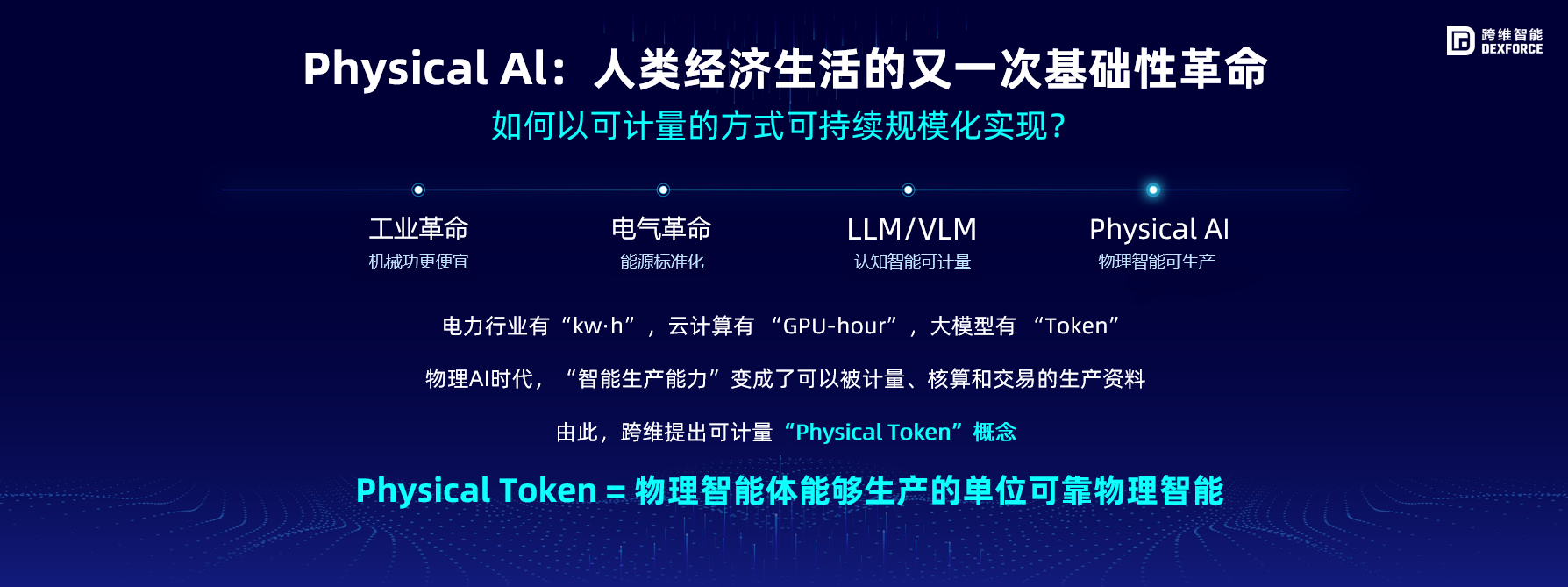
The Industrial Revolution made mechanical labor cheaper, the electric power revolution pushed energy toward standardization, and large models gave cognitive intelligence a measurable unit of information. The power industry has the kilowatt-hour, cloud computing has the GPU-hour, and large models have the Token; as AI goes further into the physical world, the output of intelligence also needs a metering approach closer to real tasks.
Unlike text generation, physical intelligence is ultimately embodied in how an agent perceives, judges and acts in a real environment: recognizing objects and their spatial relations, understanding task requirements, making motions, and reliably completing operations under complex conditions. Around this form of intelligent output, Prof. Jia offered a definition in his speech:
| Physical Token is the unit of reliable physical intelligence that a physical agent can produce.
A Physical Token is not a piece of training data, nor a simple count of robot motions. What it concerns is how much reliable physical intelligence the inputs of human labor, data and computing power ultimately produce. Only when this output can be metered can the industry further account for the production cost of a capability, compare the efficiency of different technical routes, and discuss how to keep optimizing this production system.
Therefore, the core question that Physical Token Economics seeks to answer is: toward general physical intelligence, how much human labor, data and computing power does it take to produce one unit of reliable physical intelligence?
02 To Measure Scaling, the Key Is the “Next Capability”
Getting a clear account of the cost of one capability is only the first step.
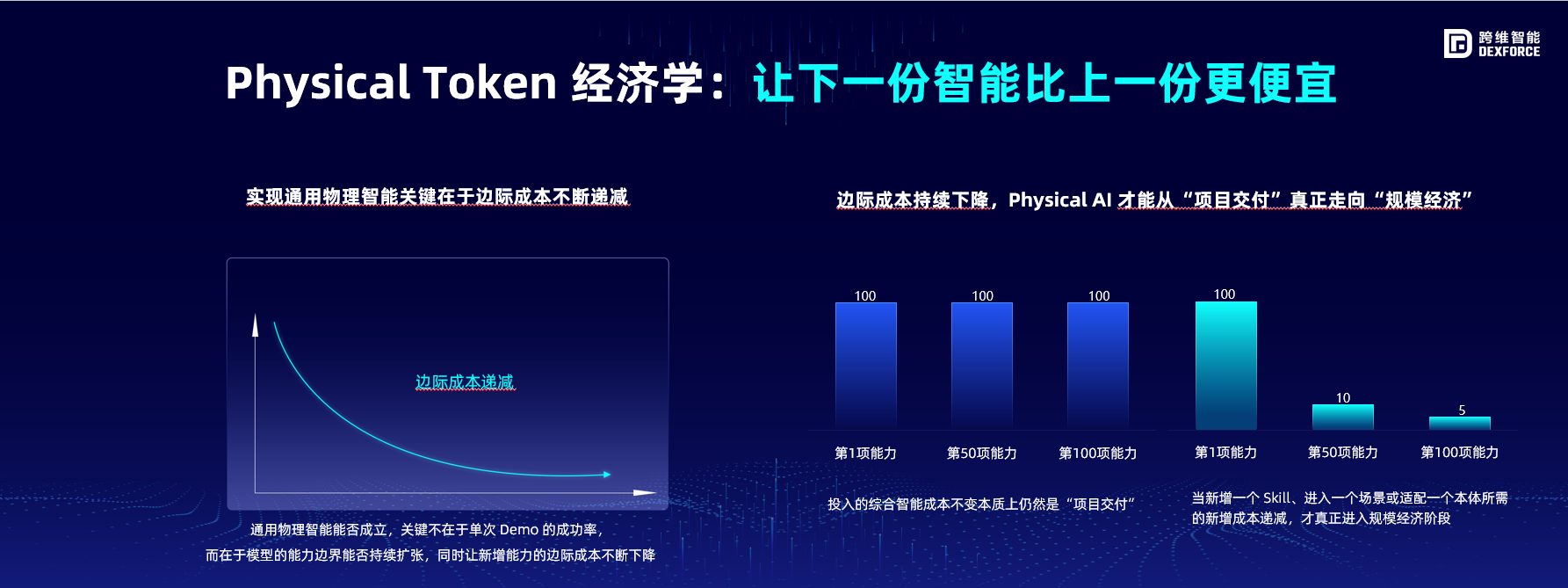
A successful demo can show that a robot already possesses a certain capability, but whether Physical AI can scale also depends on whether the system, moving from the first capability to the tenth and the hundredth, still has to pay comparable costs all over again in data collection, model training, engineering debugging and real-world trial and error.
In his speech, Prof. Jia raised two further questions: how much additional cost does it take for a robot to learn the next capability? And as the system keeps learning and being deployed, can this additional cost keep falling?
If the first Skill takes 100 units of investment and the fiftieth and hundredth Skills still take 100 units each, the business is in essence still one project delivery after another. Only when existing human experience, model capability and deployment feedback begin to serve as the foundation of the next capability, driving the incremental investment down from 100 units to 10 and then 5, does Physical AI truly meet the conditions for economies of scale.
This is also the metric that Physical Token Economics pays all the more attention to — Marginal Cost of New Capability, that is, the marginal cost of acquiring a new capability. It measures not how cheap a single training run or one task execution is, but how many more resources the system still needs when it expands to new Skills, new scenes and new embodiments.
In the view of Prof. Jia, whether general physical intelligence can stand depends not only on the success rate of a single demo, but even more on whether the capability boundary of the model can keep expanding while the marginal cost of new capabilities keeps declining. In other words, what Physical Token Economics hopes to achieve is: making the next unit of intelligence cheaper than the last.
03 Human Experience, Synthetic Leverage, Capability Condensation and Flywheel Expansion
To drive a sustained decline in the marginal cost of new capabilities, the first task is to manage the two key costs of data and models. Objects, environments, tasks and robot embodiments in the physical world vary enormously, and experience such as how objects change after a motion, how contact happens and why failures occur often has to be produced anew through real interaction or high-quality simulation.
This cost shows up mainly in three aspects: data infrastructure determines whether collection, processing and management repeatedly rely on manual labor or can settle into long-term tool assets; data acquisition determines whether the least possible amount of expensive real data can be leveraged into more effective training experience; and data representation and model learning efficiency determine whether data from different embodiments, scenes and tasks can enter a unified system and keep being reused in later capabilities.
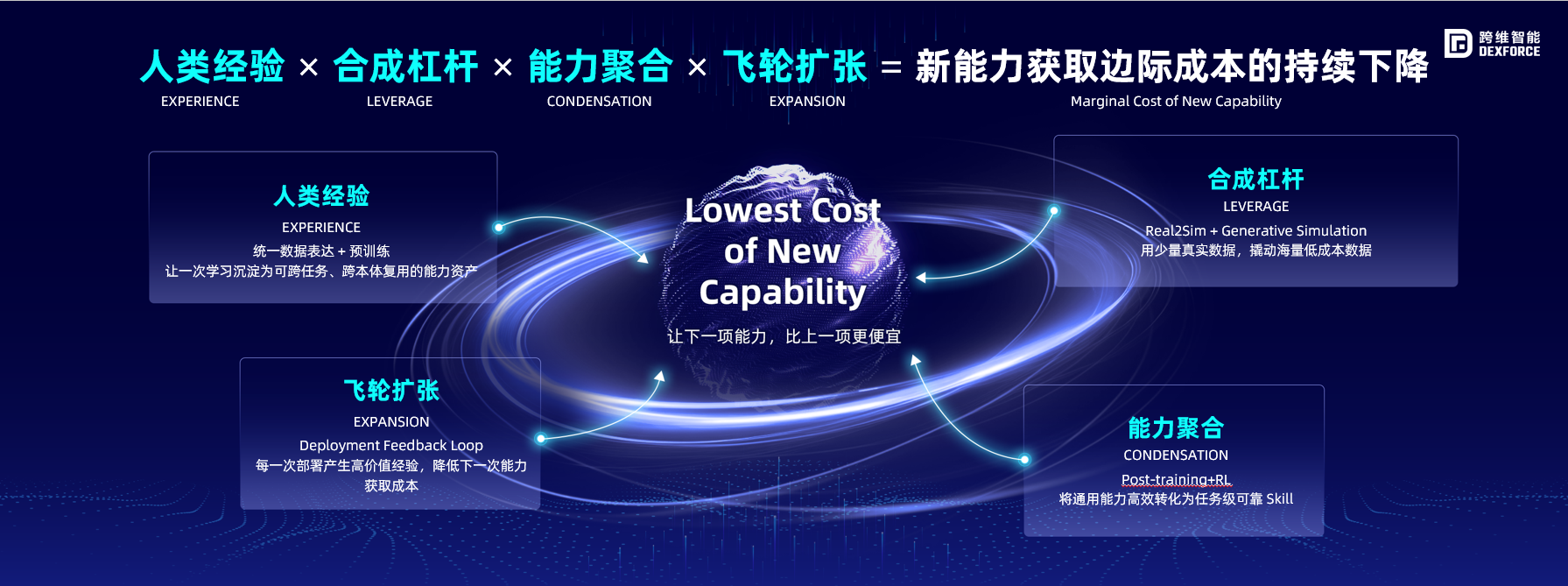
Around these questions, Prof. Jia further condensed Physical Token Economics into four interlocking core links — a capability production paradigm oriented toward the scaling of Physical AI:
| Human Experience × Synthetic Leverage × Capability Condensation × Flywheel Expansion = A Sustained Decline in the Marginal Cost of Acquiring New Capabilities
These four links are, respectively, Human Experience (EXPERIENCE), Synthetic Leverage (LEVERAGE), Capability Condensation (CONDENSATION) and Flywheel Expansion (EXPANSION).
The existing technical route and industrial practice of DexForce are unfolding along this paradigm: unified data representation and pre-training accumulate human experience; Real2Sim and generative simulation form the synthetic leverage; Post-training and reinforcement learning complete capability condensation; and real-world deployment feedback drives flywheel expansion.
1. Human Experience (EXPERIENCE): Turning a Single Learning into a Capability Asset Reusable Across Tasks and Embodiments
Real-world embodied data may come from egocentric video, simulation environments, real-robot collection, public datasets and deployment feedback, and may include RGB images, depth maps, language instructions, tactile or force feedback, joint states and end-effector trajectories. Through unified coordinate systems and a unified physical representation, DexForce Technology retains the meaningful differences among tasks, objects and interactions, and eliminates as far as possible the meaningless differences caused by coordinates, formats and calibration conventions.
Building on this idea, DexForce proposed Dexterity-BEV, bringing spatial, action and temporal alignment further into the policy training pipeline so that data from different embodiments, tasks and collection methods can enter one unified training framework; Aligned DexWorld further places heterogeneous data such as human demonstration, real-robot teleoperation and simulation into a unified space-time and action system. A single learning thus no longer serves only one project; it has the chance to settle into a capability asset reusable across tasks and embodiments, opening up a larger data space for the pre-training of embodied world models.
2. Synthetic Leverage (LEVERAGE): Using a Small Amount of Real Data to Leverage Massive, Low-Cost Data
Real data is irreplaceable, but not all training experience has to be obtained through costly real-robot trial and error. Through the domestically developed simulation engine DexVerse® and generative simulation technology, DexForce extends limited real experience to more objects, states, viewpoints and long-tail conditions, and supports high-fidelity, transferable simulation of diverse physical interactions such as deformable linear objects, soft-body cutting, cloth, liquids and articulated objects, amplifying it into large-scale, low-cost, effective training data.
Among these, the GS-World generative simulation engine brings physical simulation, motion planning and render generation into one end-to-end model. As Prof. Jia introduced, GS-World can generate a simulation task environment in a little over 10 minutes, while building the same kind of environment the traditional way usually takes 2 to 3 days in the industry. Such extreme environment generation efficiency allows models to experience more objects, states and failure situations at lower cost, providing richer physical experience for subsequent training.
3. Capability Condensation (CONDENSATION): Efficiently Turning General Capability into Task-Level Reliable Capability
Combining methods such as Post-training and reinforcement learning, DexForce performs targeted training on the spatial understanding, object semantics and manipulation priors already present in generalist foundation models, forming vertical-domain expert models for concrete tasks in industry, commerce, logistics, healthcare and other fields.
If training has to be redone from scratch for every new factory, Post-training is still just project development; if it can build on the existing foundation, making extensive use of simulation data and automated training pipelines to complete task adaptation quickly, it truly starts to become a replicable “capability production line”.
On specific vertical-domain tasks, the success rate of DexForce expert models can be raised to 99.99%, with operational precision at the sub-millimeter level.
4. Flywheel Expansion (EXPANSION): Every Deployment Generates High-Value Experience and Lowers the Cost of the Next Capability
Real-world deployment brings more than project results. The successful experience, failure cases and environmental changes that appear during operation are all high-value data that a laboratory can hardly enumerate in advance. This data returns to the training system, keeps extending the capability boundary of the model, and lays the foundation for the next entry into new tasks and new scenes.
A project is thus no longer just one delivery. It is at the same time the starting point of the next capability.
To date, DexForce has landed more than 50 application scenarios in intelligent manufacturing, commercial retail, culture and tourism services and other fields, and accumulated 1,500+ mature embodied models. Data generated in real tasks keeps flowing back into the training system and has become an important source for foundation model iteration and the development of the next capability.
From unified data to simulation amplification, from post-training to real-data feedback, this chain is by no means one-off. The more deployments there are, the richer the real problems the system encounters; and as this experience re-enters the models, it further shortens the development and delivery of the next capability.
04 Bringing Reliable Physical Intelligence to Sustainable Scale
For DexForce Technology, Physical Token Economics is a fundamental principle running through its technical paradigm, model architecture, product design and industrial implementation. By continuously lowering the marginal cost of new capabilities, DexForce hopes to bring technology back to real tasks and industrial value, accumulate capabilities that can be reused over the long term across industry cycles, and push Physical AI toward sustainable, large-scale development.
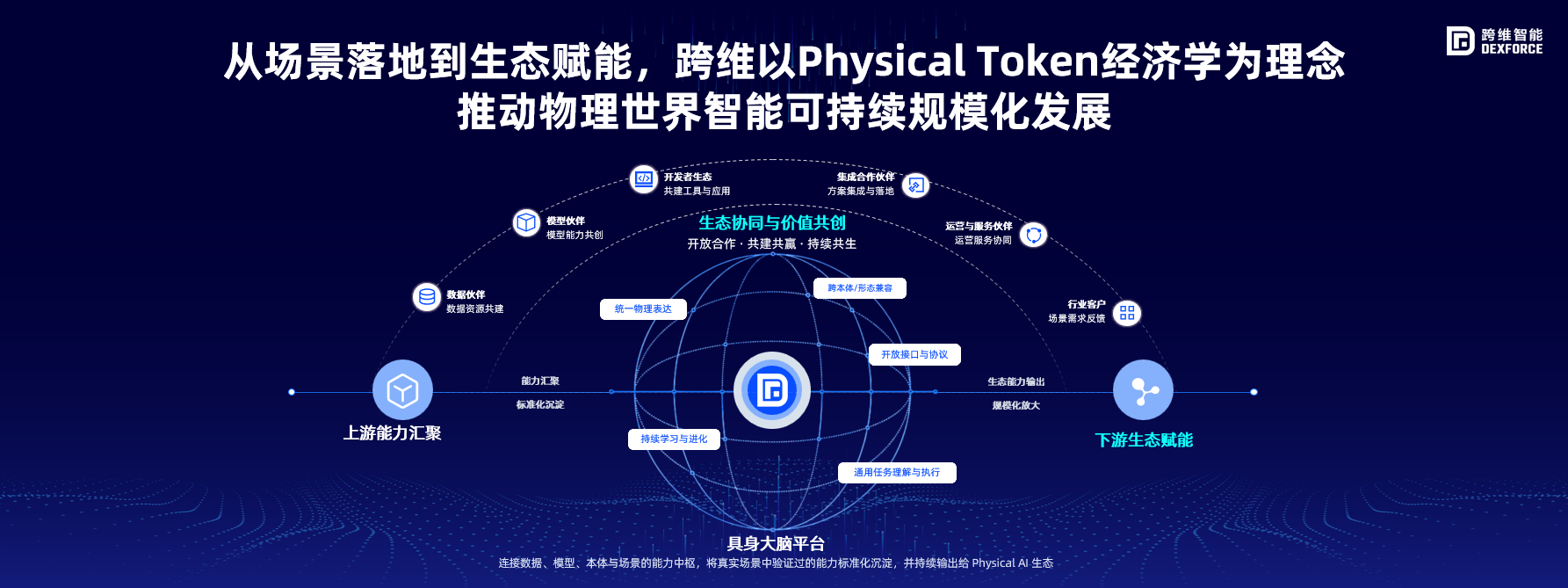
Along this direction, DexForce Technology is step by step extending physical intelligence to industrial, commercial and other scenarios. It now serves several hundred clients across industry, commerce and consumer sectors, and cooperates with a number of humanoid robot companies. The data and experience brought by different scenarios keep flowing back, becoming the foundation for model iteration and the development of the next capability.
In the next stage, DexForce will take its embodied brain platform as the core to connect data, models, embodiments and scenarios, and open capabilities verified in real tasks to embodiment manufacturers, integrators, operation service partners and industry clients, validating Physical Token Economics together with industry partners and continuously lowering the cost of capability production in real scenarios.
Making the next unit of intelligence cheaper than the last, and bringing intelligence in the physical world toward truly sustainable scale — this is the long-term proposition that DexForce hopes to explore together with the industry.