
EmbodiChain开源,用100%生成式数据自动训练具身智能模型
The Route Debate: What Robots Need Is a Physically Accurate Generative Model
The explosion of large language models let the world witness the power of the Scaling Law: with enough data and enough compute, intelligence seems to emerge on its own. In robotics, however, this formula appears to have stopped working.
-In the era of LLMs, data was an existing “stock”, and our only job was to “clean” it;
-In the era of embodied AI, data must be an “increment”, and we must be capable of “creating” it.
Unlike trillions of tokens of text readily available on the internet, the high-quality interaction data robots need — 3D-calibrated and physically consistent — is extremely scarce and expensive. This is precisely why data collection paradigms have become the absolute focus of industry research in recent years.
As we can see, the entire industry is racing at full speed toward lower cost and greater convenience: from expensive teleoperation rigs, to motion-capture-glove-based dexterous hand capture and more portable gripper solutions, to the latest innovative schemes that require no gloves at all and collect data from bare-hand demonstrations.These lightweight data collection paradigms are digitizing human experience. This path is not only full of value but also worth sustained deep cultivation, for it is the bridge connecting human skills and robot motions.
The entire industry is sprinting toward the goal of pushing embodied AI into the era of large models.
Yet even the most extreme collection efficiency remains objectively bounded by the passage of physical time and the limits of labor cost. No physical collection paradigm available today can match the “internet-scale” volume that LLM training requires. This has become the biggest shackle holding embodied AI back from higher-order intelligence.
The Efficiency Law
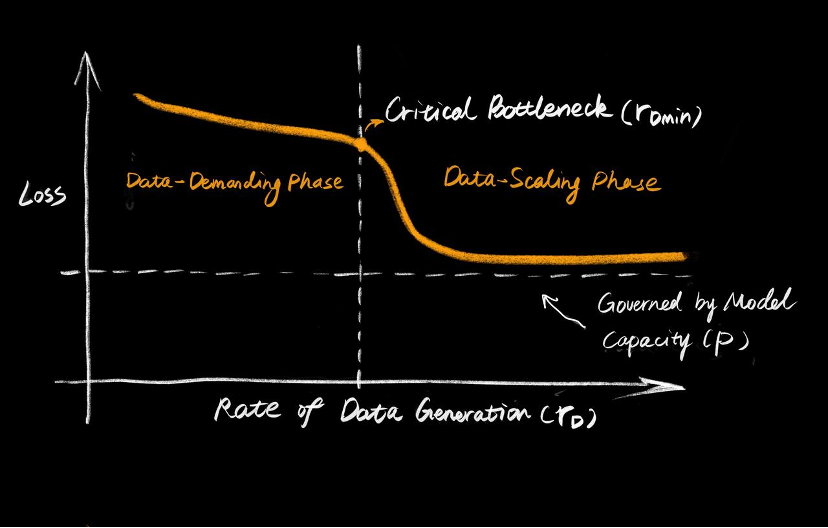
To break through this ceiling, a new perspective is required. The traditional Scaling Law focuses mainly on datasets, compute, and parameter counts. In embodied AI, however, there is an overlooked hidden variable: the rate of data generation (rD).
This is the core insight the DexForce Technology team put forward in the GS-World paper: the evolution of intelligence has an “escape velocity”.
-The bottleneck phase: when data generation is too slow (relying on manual collection or slow simulation), no amount of model parameters helps, because the model is “underfed”.
-The explosion phase: only when rD exceeds the critical value rminD and data is no longer a scarce resource but flows as endlessly as tap water does model performance release linearly with the growth of parameters.
To cross this chasm, beyond continuously refining physical collection, another highly promising solution is to build a digital world that generates physical reality at ultra-high speed and fully automatically (the DexForce team detailed this path in the GS-World paper).
In this physics-engine-based generative world, the rate of data generation transcends the limits of time (the Efficiency Law); robots can acquire a deep understanding of physical causality through zero-cost trial and error; and every corner case can be simulated and conquered here.
GS-World and EmbodiChain
Today, DexForce Technology officially open-sources EmbodiChain. As the cornerstone on the road to GS-World (a world model built on generative simulation) , EmbodiChain is not merely a data and model platform, but a reconstruction of the learning paradigm of embodied AI.
The DexForce team proposed and validated a bold hypothesis: with nothing but 100% generative simulation data, as long as the rate of generation breaks through the critical threshold, robots can demonstrate generalization in the real world that surpasses SOTA.
This is not science fiction. It is the Efficiency Law that DexForce is now validating.
In essence, EmbodiChain is a data and model manufacturing engine that pushes rD to the maximum. It no longer depends on finite sampling of the real world; instead, it opens the door to the mass manufacture of physically realistic data.
Turning GS-World from blueprint into reality, however, is far from easy. The DexForce research team must confront and conquer three core scientific challenges, which are exactly the problems EmbodiChain is committed to solving:
1. How can data production be automated?
The real world is enormously complex. How can we automatically reconstruct and generate vast, physically consistent scenes and tasks in a digital world from just a sliver of prior knowledge (a short video, a single sentence of description), without any manual scene building
2. How can the “Sim2Real Gap” be bridged?
However much simulation data there is, it is futile if it cannot transfer to real robots. How can models learn robust policies that withstand the noise and dynamic changes of the real world, without fine-tuning on real data, or with as little as possible
3. How can the “IO wall” of data generation be broken through?
Scaling requires hundreds of millions or even billions of interaction steps. The traditional “generate, store, read, train” pattern is extremely inefficient. How can we build a supremely efficient data flow mechanism and achieve an “online data stream”?
EmbodiChain: A Never-Stopping “Online Data Stream and Model Production Line”
To realize this vision, DexForce Technology built the core cornerstone of GS-World (Generative Simulation World Model) — EmbodiChain.
As an underlying infrastructure technology, EmbodiChain can be seen as a digital pipeline with storage stripped out. Scaling requires hundreds of millions or even billions of interaction steps, and when the traditional “generate, store, read, train” pattern meets massive 3D data, storage and transport become an unbearable burden.
The EmbodiChain architecture does away with the outdated paradigm of writing to disk first and reading it back later, replacing it with online data streaming and an automated model production line.
How does this pipeline work?
-World Generation (Generative Simulation): The engine is not just the environment, but the creator. The Real2Sim module extracts physical priors from very few real samples, while the Gen2Sim module responds to language commands and automatically builds 3D scenes and assets that obey the laws of physics, Newtonian mechanics included.
-Data Scaling: Data must not only be abundant, but also “hard”. The system automatically applies visual augmentation and physical parameter randomization, and prunes invalid samples the robot “cannot reach”.
-Self-Repair (Closed-loop Recovery): True intelligence comes from learning from mistakes. When a grasp fails in simulation, the system automatically generates corrective trajectories. This closed loop of “failure, correction” is more valuable than successful demonstrations alone.
All of this runs in parallel at high speed inside the GPU. Data gushes out like a torrent and is destroyed the moment training consumes it, leaving no redundancy behind, only the growth of model capability.
On the road to an embodied AI world model, two sharply different routes currently exist.
One is the recently red-hot video generation route (Video World Model), such as Sora or LTX-Video, which try to simulate the world by “painting” the next frame. The visuals are stunning, but comparative experiments have exposed a fatal weakness: hallucination.
The imagery produced by video models often lacks long-range spatiotemporal consistency and can hardly follow the equations of dynamics exactly. Training robots on data born of such “dreaming” is like teaching a pilot to fly in the wonderland of Alice — lovely to watch, yet it crashes the moment a real robot is involved.
EmbodiChain, by contrast, takes the GS-World route (a world model built on generative simulation).
-Physical Priors: DexForce Technology insists that a world model must be 3D, interactive, and physically rigorous.
-Privileged Information: In EmbodiChain, the user holds a god-like view. For instance, the user can obtain exact object masks, spatial relations, and affordances. By training the model to predict this “privileged information”, invisible in the real world, the model is forced to understand the geometric essence behind a scene rather than merely the pixels on the surface.
This is exactly the idea Yann LeCun advocates: a world model should be prediction and planning over the state of the world.
Zero Real Data: Can a VLA Really Work?
To verify this Efficiency Law, DexForce Technology ran an extreme test: training a model with no real data at all.
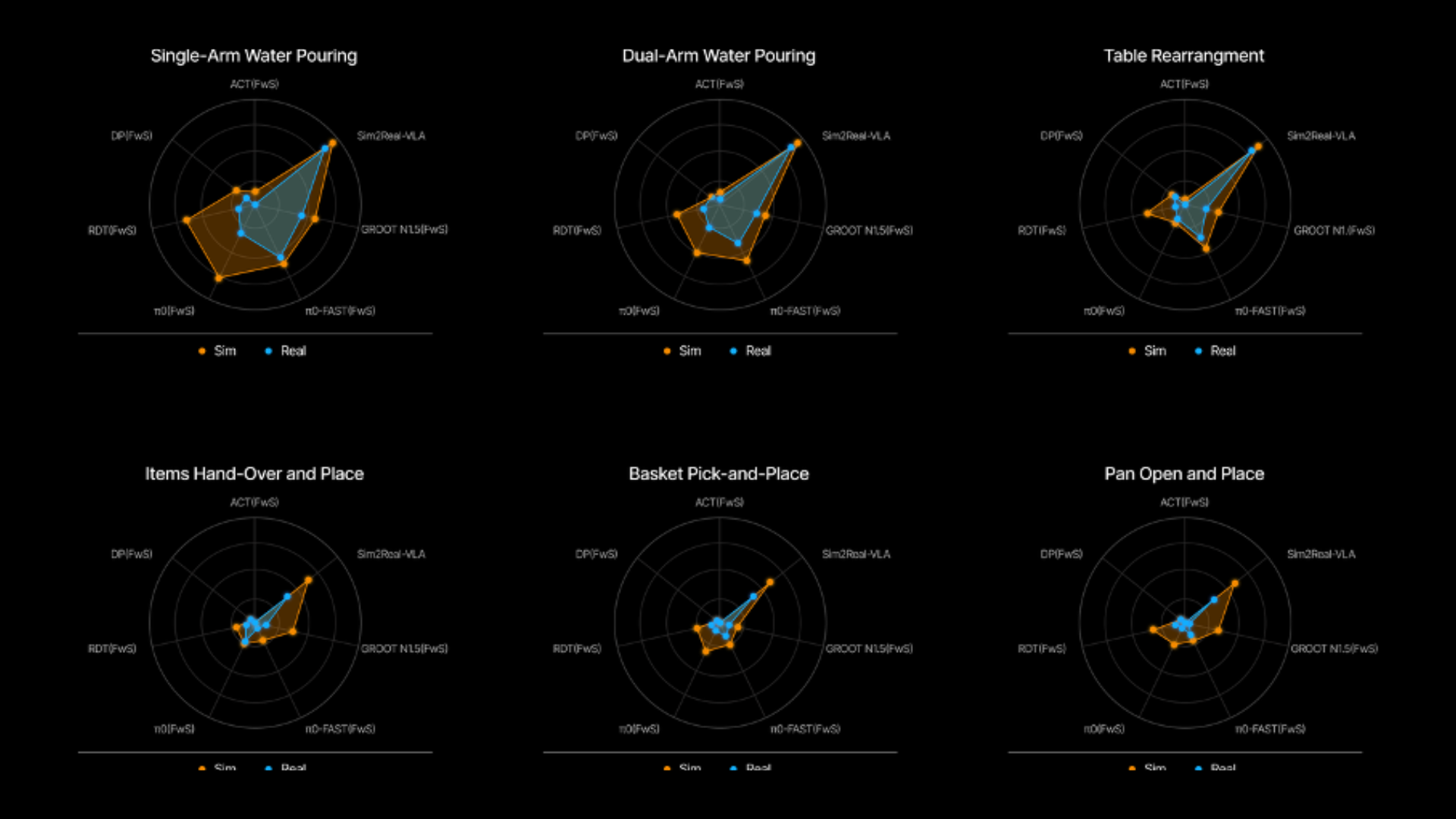
The Sim2Real-VLA model trained by DexForce executes tasks in the real world. The results are striking:
-Far beyond the baselines: without any fine-tuning on real data, it leads mainstream methods such as ACT and Diffusion Policy by a wide margin in manipulation success rate.
-Undisturbed by disruption: even when DexForce plays the “saboteur” — changing the tablecloth, moving objects, altering the lighting — the model stays rock solid. On some tasks, with the background noise that real data easily overfits to removed, it even outperforms models trained on real data.
The Vision: The “Efficiency Singularity” on the Road to GS-World
Open-sourcing EmbodiChain is only a beginning.
The GS-World blueprint goes far beyond this. In the planning of DexForce Technology, this is an Engine-driven Loop:
-The environment is generated, and so are the tasks;
-The policies evolve, and the robot body (morphology) co-evolves with the demands of the tasks.
DexForce Technology hopes EmbodiChain will become the infrastructure of every embodied AI researcher. No more teleoperating day and night in the lab for a few thousand samples, and no more worrying about dozens of TB of hard-drive storage.
Because the future of intelligence should not be trapped in a scarcity of data.
EmbodiChain is now open source, and you are invited to witness the “efficiency singularity” of embodied AI.
-Paper: https://www.techrxiv.org/doi/full/10.36227/techrxiv.176153394.41323502
-Open-source homepage: https://dexforce.com/embodichain/index.html#/
-Code repository: https://github.com/DexForce/EmbodiChain
-Technical documentation: https://dexforce.github.io/EmbodiChain/introduction.html